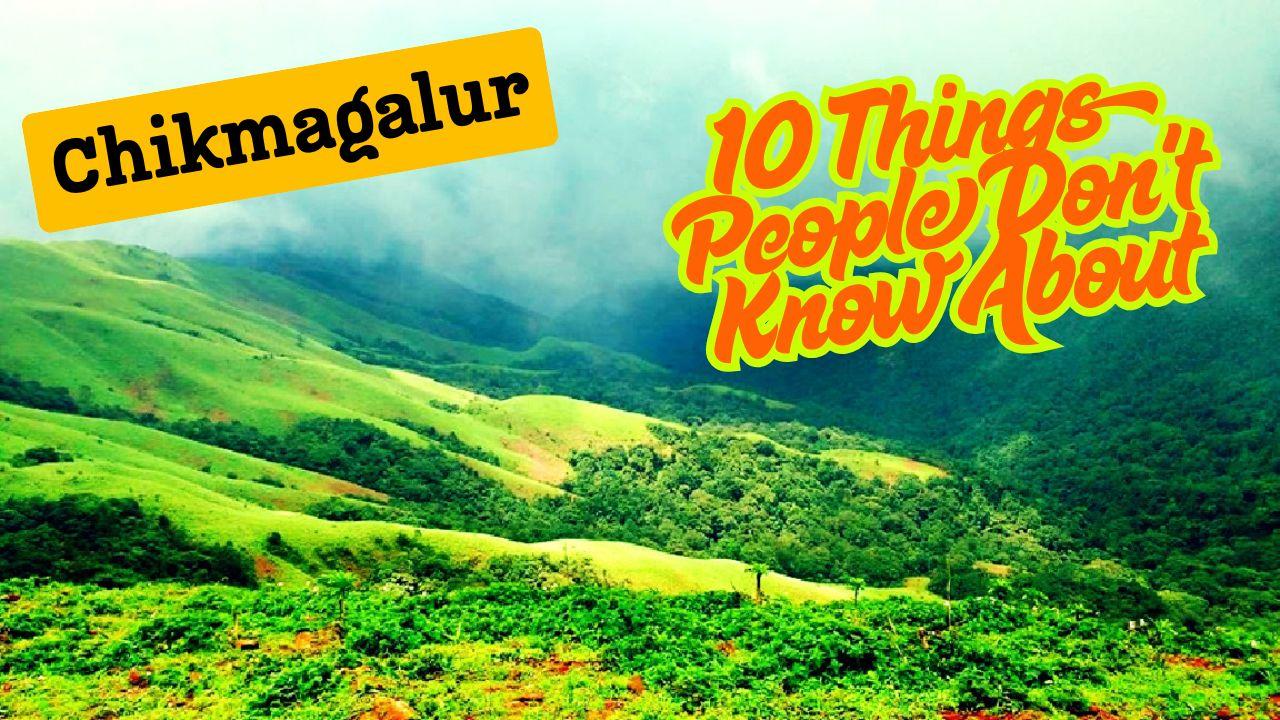
10 Things People Don't Know About Chikmagalur
Chikmagalur isn't just coffee plantations — the 7 smuggled beans that started Indian coffee, a Sufi-Hindu shared shrine, the Hoysala dynasty's first temple, and 7 more things even regulars miss.
Beyond the postcard version of Chikmagalur
Type "Chikmagalur" into any travel blog and you'll get the same five suggestions: Mullayanagiri sunrise, Hebbe Falls, Bababudangiri, a plantation homestay, Hirekolale Lake. All real, all fine, all in every listicle on Indian travel.
The interesting stuff isn't on those lists. Chikmagalur sits on a geology that birthed Indian coffee, hosts one of the country's most remarkable Hindu-Muslim shared shrines, has the Hoysala dynasty's earliest known temple, and contains a quiet conservation success that most Indians have never heard about.
This is the version of Chikmagalur that locals know and travel blogs skip.
1. Indian coffee began with seven beans smuggled in a beard
The story is true and the specifics are stranger than the legend suggests. In the 17th century, an Indian Sufi saint named Hazrat Shah Janab Allah Magatabi — known as Baba Budan — was returning from Hajj and stopped at the port of Mocha in Yemen. Coffee was already widely consumed in the Arab world but its export was tightly controlled — Yemeni traders would only sell roasted beans, never green ones, to prevent cultivation elsewhere.
Baba Budan reportedly smuggled out seven green coffee beans hidden in his beard. The number seven is religiously significant in Sufism (the seven heavens, the seven attributes), so the choice was symbolic rather than practical.
He planted those beans in the hills near Chikmagalur — what is now the Bababudangiri range — sometime in the 1600s. Every single Indian coffee plant alive today traces its lineage to those seven seeds. The country that's now the world's seventh-largest coffee producer started with a smuggling operation hidden in facial hair.
Verify: the year is variously cited as 1600, 1670, or 1695 across sources. Historians of Indian coffee generally settle on "mid-to-late 1600s" but the specific year is contested.
2. Karnataka's highest peak is named after a Sufi saint
Mullayanagiri — at 1,930 meters, the tallest peak in Karnataka — is the headline trek for every Chikmagalur visitor. Almost everyone assumes the name is Sanskrit-derived. It isn't.
The name comes from Mullappa Swamy, a Sufi saint who is said to have meditated in a small cave near the summit centuries ago. "Mullappana giri" → "Mullayana giri" → the modern Kannada "Mullayanagiri" — literally, "Mullappa's hill."
There's a small temple at the top dedicated to Lord Shiva, but the peak's name remembers the Sufi saint who lived there first. The peak you photograph at sunrise carries a Sufi etymology.
3. India's most prominent Hindu-Muslim shared shrine sits on the next hill
Twenty-eight kilometres north of the town, on Bababudangiri, sits a cave-shrine known as the Dattatreya Peetha in Hindu tradition and as the dargah of Hazrat Dada Hayat Mir Khalandar in the Sufi tradition.
For centuries — possibly four hundred years — both faiths have worshipped at the same site. Hindu pilgrims revere it as the cave where Lord Dattatreya appeared. Sufi devotees revere it as the seat of a Pir of the Qadiri order. The same lamp is lit, the same caves walked, often by the same families who have done both for generations.
The shrine has been at the center of a long-running ownership and management dispute that has reached the Karnataka High Court and the Supreme Court of India. As of recent rulings, joint management arrangements continue, though contested.
It's one of the rare living examples of South Indian religious syncretism — and most Chikmagalur tourists pass through it without realising what they're walking into.
Verify: the case status changes year to year. Confirm the latest SC/HC rulings before publishing.
4. The Hoysala dynasty's earliest known temple is here, not at Belur
The Hoysalas (10th–14th centuries) are best known for the temples at Belur and Halebidu — both UNESCO World Heritage sites, both wildly photographed.
But Belavadi, just 15 km from Chikmagalur town, contains the Veera Narayana Temple — believed by Karnataka's archaeological historians to be one of the earliest Hoysala-era temples, predating Belur in some accounts.
What's special about Belavadi:
- It's a trikuta (three-shrine) temple — Vira Narayana, Yoga Narasimha, and Venu Gopala — all three forms of Vishnu in a single complex
- The pillars are lathe-turned, characteristic of mature Hoysala craftsmanship
- It receives perhaps 1% of the visitor traffic of Belur
- Photography is permitted, the priest is welcoming, and there's no entry fee
If you're already in Chikmagalur and even mildly interested in temple architecture, this is a 30-minute detour with the highest signal-to-tourist ratio in the region.
Verify: the "earliest Hoysala temple" claim is debated; some historians give that title to Doddagaddavalli. Frame as "one of the earliest" rather than "the earliest" if uncertain.
5. A "presumed extinct" civet still lives in the Chikmagalur range
The Malabar Civet (Viverra civettina) — a slim, raccoon- sized carnivore endemic to the Western Ghats — was last photographed in the wild around the early 1990s. By 2008, the IUCN listed it as Critically Endangered (Possibly Extinct).
In recent years, camera-trap evidence and direct sightings in the Kudremukh-Bhadra-Sharavathi corridor that includes parts of Chikmagalur district has suggested the species clings on in isolated forests. It's one of the most secretive mammals in peninsular India — nocturnal, solitary, and almost never seen even by forest rangers.
You will not see a Malabar Civet on your trip. But knowing the forest you're walking past might still hold one is part of why preserving these landscapes matters more than the views you came for.
Verify: cite the specific recent camera-trap study before publishing — there were several papers between 2018-2024 on small carnivores of the Western Ghats.
6. Kuduremukha shut down India's first big iron-ore mine for biodiversity
About 90 km west of Chikmagalur town, Kudremukh National Park (the name means "horse face" — the peak's profile resembles one when viewed from the south) is part of one of the rarest ecosystems in the country: shola-grassland montane forest.
For three decades, Kuduremukh was synonymous with Kudremukh Iron Ore Company Ltd. (KIOCL), a major exporter that operated open-cast mines from the 1970s. The mining dramatically scarred the landscape and silted the Bhadra and Tunga rivers downstream.
In 2002, after a long environmental case, the Supreme Court of India ordered the mine closed. KIOCL ceased operations by 2005. It was India's first major industrial shutdown ordered purely on biodiversity grounds — predating most of today's environmental judgments.
Two decades later, the forest is recovering. The peak is open to trekkers (with forest department permits) and the river systems have visibly cleaner flows.
7. Bhadra Tiger Reserve quietly tripled its tiger count
The Bhadra Wildlife Sanctuary, on the eastern edge of Chikmagalur district, is one of India's quieter conservation wins. It became one of the first tiger reserves under Project Tiger — formally declared in 1998 — but it had a slow start.
The decisive move was a village relocation programme between 2000 and 2002. Roughly 24 forest villages — about 700 families — were peacefully resettled outside the reserve, with land, houses, and rehabilitation packages. It was one of the few large-scale conservation relocations in India that resettled communities with their consent and without violence — and it's still cited by ecologists as a model.
After relocation, tiger numbers grew steadily. The latest counts suggest 30+ tigers in the reserve, up from the single-digit estimates of the 1990s. You're not guaranteed a sighting on a safari but the population is healthy and growing.
Verify: latest tiger census (NTCA reports the all-India figure every four years) for current Bhadra count.
8. The Coffee Research Station holds 600+ Arabica varieties
The Central Coffee Research Institute (CCRI) at Balehonnur, about 50 km from Chikmagalur town, is the research arm of the Coffee Board of India.
Founded in the early 20th century, CCRI maintains India's largest coffee germplasm collection — a living seed bank of Arabica and Robusta varieties. The collection includes:
- Wild Arabica strains brought from Ethiopia in the 1950s-60s
- Local mutations developed in the Coffee leaf rust crisis of the late 19th century
- Hybrid varieties bred for Indian conditions
- Heritage strains from the original Bababudangiri plantings
You can't visit casually — it's a research institute, not a tourist site — but if you're a coffee enthusiast, scheduled visits are possible by writing to CCRI Balehonnur. They occasionally run open days during the planting season.
The genome work happening here is why Indian coffee remains distinctive: most of what you drink as "South Indian filter coffee" descends from CCRI-bred lines.
9. Sringeri's matha is one of the four cardinal seats of Advaita Vedanta
About 80 km from Chikmagalur (still in Chikmagalur district), Sringeri Sharada Peetham is one of the four cardinal mathas established by Adi Shankaracharya in the 8th–9th century to formalise Advaita Vedanta philosophy.
The four mathas — Sringeri, Dwaraka (Gujarat), Puri (Odisha), and Jyotirmath (Uttarakhand / Badrinath) — anchor the philosophical and administrative continuity of Advaita Hinduism. Sringeri is traditionally regarded as the first of these to be founded, though scholarship on the exact chronology varies.
The matha sits on the banks of the Tunga river. The Vidyashankara Temple within the complex is itself an architectural marvel — its 12 zodiac pillars are calibrated so that sunlight strikes a different one each month. The fish in the Tunga at the matha are protected by tradition and form an unusual sight: large, unafraid, swimming around visitors' feet.
It's not in most travel itineraries because the route from Chikmagalur is long (3-4 hours each way) — but for travelers with one extra day, it's a humbling reminder that this hill country has shaped Indian thought for over a millennium.
Verify: scholars debate the founding date of Sringeri Matha. Frame conservatively as "traditionally dated to the 8th-9th century" rather than asserting a specific year.
10. Coffee tourism here predates Indian independence
Several plantation bungalows in the Chikmagalur range still operate as homestays — and a few of them date back to the 1880s-1910s when the British coffee planters built them.
These weren't built as guesthouses. They were the residences of British plantation managers, with separate quarters, mess halls, and storerooms. The earliest "guests" were British surveyors, geologists, and travel writers visiting on official business in the 1880s.
After independence, many estates were acquired by Karnataka families — often Brahmin or Kodava — who continued the plantation operation and gradually opened parts of the bungalow to paying visitors. By the 1990s, plantation tourism was a modest but real revenue stream. Today it's a defining feature of Chikmagalur stays.
If you book a homestay on a working estate, ask the owner about the bungalow's history. Several have written records, photographs, and original British-era furniture. A handful maintain the original wood-burning kitchens and serve breakfast on the same dining tables that hosted colonial planters 130+ years ago.
That continuity — across the British era, post-independence acquisition, and modern tourism — is harder to find anywhere else in India.
Bonus: a few more nobody mentions
- Hirekolale Lake is technically a reservoir on the Yagachi river, not a natural lake. The "lake" identity comes from postcards.
- Hebbe Falls is best photographed in the morning before the mist clears; afternoon photos lose the depth.
- Z Point is named because the trail forms a shape resembling a Z — not because it's the "last point" or any mystic reason some blogs invent.
- Mullayanagiri's metal staircase (the famous final approach) was built in the 1990s; older photos of the peak don't show it.
- The drive from Chikmagalur to Sakleshpur (toward the coast) is an underrated two-hour scenic loop through coffee, tea, and pepper estates.
Plan a Chikmagalur trip the smart way
If this article got you interested in something deeper than "trekking + waterfalls," structure your trip around one of these themes instead:
| Theme | Day 1 | Day 2 | Day 3 |
|---|---|---|---|
| Coffee history | Plantation homestay arrival | Bababudangiri + CCRI Balehonnur | Estate walk + return |
| Hoysala architecture | Town + Belavadi | Belur + Halebidu day trip | Doddagaddavalli + return |
| Spiritual + philosophical | Bababudangiri | Sringeri + Vidyashankara | Horanadu Annapurneshwari + return |
| Pure landscape | Mullayanagiri sunrise | Kuduremukh trek | Hebbe Falls + return |
Whichever you pick, the headline pitch — Chikmagalur is more than coffee plantations — is a starting point, not the destination. There's a layered history under every hill.
For another curated Karnataka-adjacent trip, see our Char Dham Yatra guide for the Himalayan yatra circuit, and the Vaishno Devi guide for the most popular pilgrimage in north India — both follow the same "what no first-timer is told" structure as this piece.
Frequently asked questions
September to February — post-monsoon greenery is at its peak, temperatures sit in the 15-25°C range, and the coffee plants are in flower or fruit depending on the month. Avoid June-August (heavy rain, leeches on every trail) and April-May (hot, hazy, water shortage).
Vikas
Founder & Editor
Founder of Bharat Sarvaseva. Writes on Indian taxes, government schemes, and citizen services with a focus on actually getting things done.
Related reading

10 Things People Don't Know About Spiti Valley
Beyond the Instagram photos: 10 things about Spiti Valley most travellers miss — the Inner Line Permit nobody asks for, the world's highest village, why the monasteries matter, and the real cost of altitude.

BRICS Expansion 2026: What India Actually Gets (and What It Doesn't Want)
How BRICS grew from 5 to 10+ members, why India agreed despite reservations, the 'BRICS currency' that isn't happening, and what India will and won't accept from the bloc.
China–India LAC Tensions 2026: What's Actually Happening on the Border
Where the China–India border standoff actually stands in 2026 — the four friction points still active, disengagement vs de-escalation, and what 'managed rivalry' costs India.