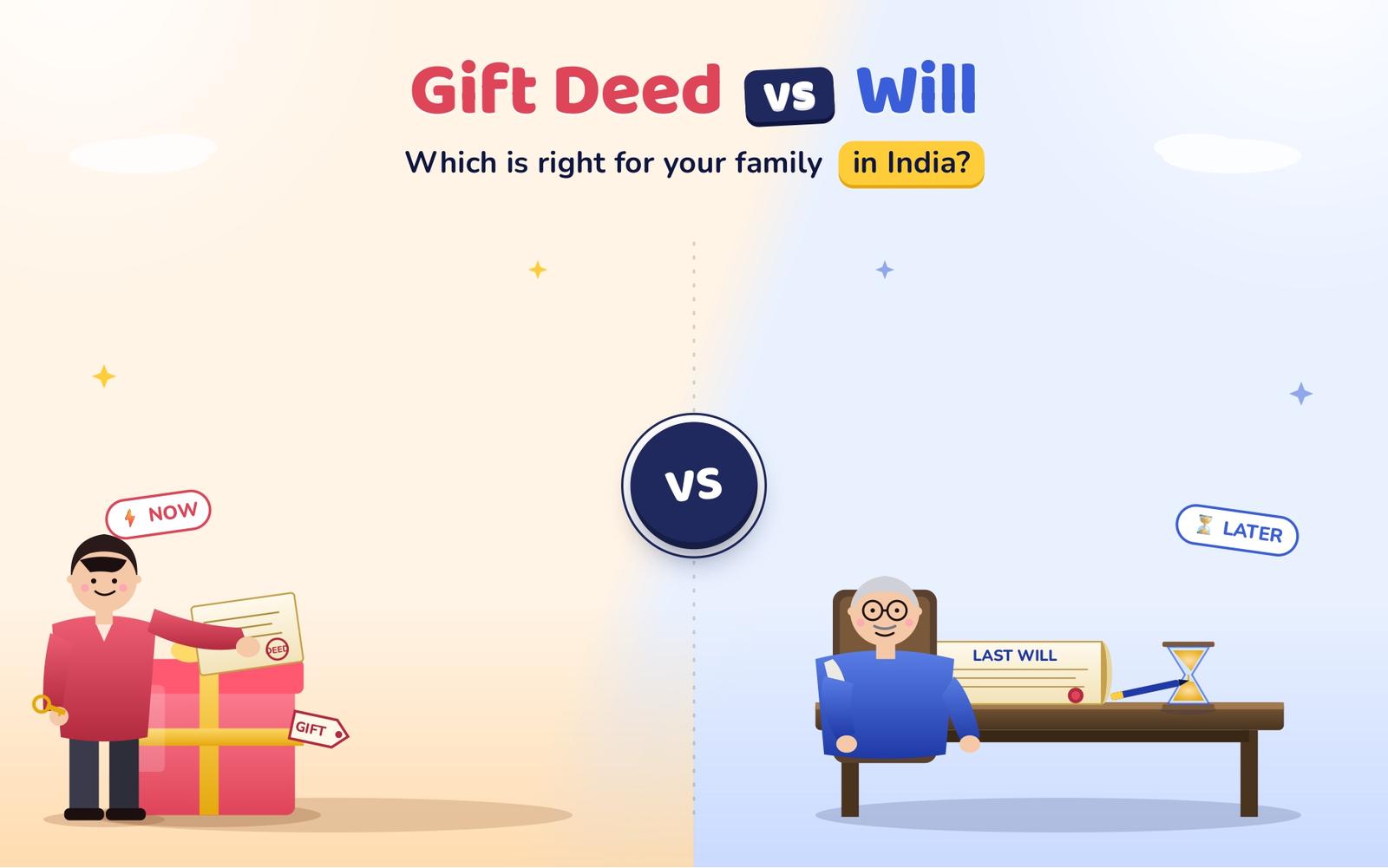
Gift Deed vs Will: Which Is Better for Property Transfer in India?
The ₹4 lakh mistake most Indian parents make when transferring property to children — gift deed vs will compared on cost, tax, control, and disputes.
The ₹4 lakh question every Indian parent faces
A father walks into his lawyer's office in Bengaluru. He owns a flat worth ₹1.2 crore. He wants his son to have it. The lawyer asks: "Gift deed or Will?" — and that single answer can cost or save the family between ₹4 and ₹8 lakh in stamp duty alone, plus years of court fees if disputed later.
Most Indian families default to "let's just write a Will" because it feels lighter. Sometimes that's right. Often it isn't.
The fundamental difference in one paragraph
A gift deed transfers ownership immediately upon registration. The moment the Sub-Registrar stamps it, the property is your son's — even if you change your mind tomorrow. A Will transfers ownership only after death. Until then, you're free to sell, change beneficiaries, or tear the document up.
That single distinction drives everything else: cost, tax, control, risk of dispute, and what makes sense for your family.
Side-by-side comparison
| Factor | Gift Deed | Will |
|---|---|---|
| When does it transfer | Immediately on registration | On the testator's death |
| Reversible? | No (with rare exceptions) | Yes — anytime, any number of times |
| Stamp duty | 0.5%–7% depending on state + relation | None |
| Registration | Mandatory | Optional (but recommended) |
| Court challenge risk | Low | Higher — common for high-value estates |
| Probate required | No | Sometimes (Mumbai, Kolkata, Chennai) |
| Legal heirs' claim | Excludes them automatically | They must respect the Will but can challenge |
| Best for | Single heir, certain decision | Multiple heirs, future flexibility |
When a gift deed is the right call
Pick a gift deed when:
- You have one clear heir — there's no other child, sibling, or spouse with a competing claim
- You want absolute certainty the property won't end up disputed in court 20 years from now
- The property is undisputed — no family member is currently claiming partial ownership
- You're doing it for a tax or financial planning reason — e.g., you want the property income on your son's PAN starting now
- You're confident in your decision — and won't regret it during a family conflict 10 years later
A gift deed with a reserved right of residence is the most underused tool in Indian estate planning. It transfers ownership to your child but keeps your lifetime right to live in the property. You get the certainty of a gift deed without losing your home.
When a Will is the right call
Pick a Will when:
- You have multiple heirs and want to specify who gets what
- You want to keep the right to change your mind (most common reason among middle-class Indians)
- The estate involves bank accounts, FDs, mutual funds, ornaments in addition to property — a Will covers everything in one document
- You're young and circumstances may change — don't lock in a decision at 50 for a property you might want to sell at 65
- You want minimum out-of-pocket cost today — Wills are essentially free to write; gift deeds aren't
Stamp duty — the real number
This is where most online articles handwave. Actual concessional rates for transfer between blood relatives in major states:
Replace with verified current rates from each state's stamp act — these vary by year and gazette notifications.
| State | Rate to blood relative | Rate to non-relative |
|---|---|---|
| Maharashtra | ~3% (concessional) | 5% + 1% local body tax |
| Karnataka | ~1% + cess (huge concession) | 5–6.5% |
| Tamil Nadu | ~1% (concessional) | 7% + 4% registration |
| Delhi | 4% (men) / 6% (women) — full | Same |
| Telangana | ~0.5% to lineal heir | 4% |
| Gujarat | ~3.5% (concessional) | 4.9% |
| West Bengal | 0.5% (lineal heir) | 6%+ |
On a ₹1 crore property in Karnataka, that's the difference between ~₹1 lakh (gift to son) vs ~₹6.5 lakh (gift to nephew) vs ₹0 (Will, nothing payable until probate).
The hidden cost most articles miss: probate
A registered Will doesn't automatically transfer property on death. In Mumbai, Kolkata, and Chennai (under the original Indian Succession Act jurisdiction), a Will involving immovable property typically requires probate from the High Court — which costs:
- Court fees: 0.5%–4% of the asset value (capped, varies by state)
- Lawyer fees: ₹50,000 to ₹3 lakh+ depending on complexity
- Time: 6 months to 3 years if uncontested, longer if challenged
In other Indian cities, probate is generally not mandatory, but a succession certificate may still be required to update banks and the property register.
So a "free" Will can become an expensive court process at the worst possible time — when the family is grieving.
Tax — both options can be tax-free
Income tax under Section 56(2) treats gifts from specified relatives as fully tax-free for the recipient, regardless of value. Specified relatives include:
- Spouse
- Parents and parents-in-law
- Children
- Siblings
- Lineal ascendants and descendants (grandparents, grandchildren)
So a gift deed from father to son: tax-free for the son. Inheritance via Will from father to son: also tax-free (India has no inheritance tax).
Where tax kicks in:
- Gift to non-relative > ₹50,000: fully taxable in the receiver's hands
- Sale of inherited / gifted property later: capital gains apply (with cost basis from the original acquisition by the donor)
For property income (rent), both routes shift the income to the receiver's PAN — useful if the parent is in a higher tax bracket.
How to draft each
Gift deed — the legal essentials
A valid gift deed must include:
- Names and addresses of donor (giver) and donee (receiver)
- Detailed property description — survey number, area, boundaries
- Statement of voluntary transfer without consideration
- Donee's acceptance clause
- Possession transfer clause (immediate or reserved)
- Reservation clauses if any (right to reside, right to income, etc.)
- Two witnesses + signatures
- Stamp duty paid + registration at the Sub-Registrar's office
Do not use generic online templates for any property worth more than ₹25 lakh. Hire a lawyer — typical fee ₹5,000 to ₹25,000 — and the lawyer handles the registration paperwork as part of that.
Will — the legal essentials
A valid Will (under the Indian Succession Act, except for Muslims who follow Muslim Personal Law) needs:
- Testator's name and clear declaration of being of sound mind
- Specific bequest clauses — who gets what
- Executor appointment — the person responsible for distribution
- Date and place of execution
- Two witnesses — neither of whom is a beneficiary (this is a common mistake; it makes the bequest to that witness void)
- Testator's signature on each page
Registration is optional but adds significant evidentiary weight. Cost to register: typically ₹100–₹500 across most states.
A decision tree
Use this to pick:
- Do you have multiple potential heirs (other than the receiver)? → Will (specifies your wishes), or gift deed if you want to settle disputes now and exclude others.
- Do you want to keep the right to change your mind? → Will. Don't even consider a gift deed.
- Is the property worth more than the stamp duty cost? This is almost always true — but for very low-value rural properties, the stamp duty + lawyer cost may exceed the practical benefit. → Will.
- Do you want the receiver to be free of any future succession challenge? → Gift deed (registered). It's litigation-proof in 95% of cases.
- Are you in good health and under 70? → Either works. Lean towards Will unless one heir is unambiguous.
- Are you in failing health, single heir clear, and want zero post- death legal mess? → Gift deed today.
Common mistakes that cost lakhs
- Hand-writing a Will on plain paper — perfectly legal but easy to challenge. Use stamp paper (₹100 is enough) and register it.
- Naming a beneficiary as a witness — voids that bequest entirely
- Gift deed without specifying boundaries — leads to ambiguity if property is sub-divided later
- Using a "deed of gift" template from Google for ₹2 crore property — even a small drafting error can be exploited in court
- Not telling the executor / family where the Will is kept — happens more often than you'd think; original Will is lost, copy is challenged
- Keeping two Wills — only the latest dated one is valid, but the existence of multiple Wills is itself grounds for litigation
Bottom line
The "gift deed vs Will" question is really three questions stacked: how certain are you, how much liquidity do you have today for stamp duty, and how much risk-of-future-dispute can your family tolerate?
For a single-heir, undisputed property, gift deed is the cleaner finish — pay the duty once, sleep well for 30 years.
For a multi-heir estate with bank accounts, mutual funds, jewellery, and property mixed together, Will is the only practical option — but register it, keep it updated, and use a lawyer.
Either way, don't put off the paperwork. Indian courts are full of families fighting over assets the deceased had every intention of distributing peacefully. Document the intent while you can.
For the related decision on whether to claim the property income under the old or new tax regime, see our old vs new tax regime guide. For step-by-step rent-agreement drafting (often part of property transfers with retained-residence clauses), see the rent agreement guide.
Frequently asked questions
Once executed and registered, a gift deed is irrevocable except in three narrow situations: it was obtained by fraud, coercion, or undue influence; or there's a clause in the deed allowing revocation; or the donor and donee mutually agree to cancel via a separate registered cancellation deed. This is the single biggest difference from a Will — once the deed is signed, your property is no longer yours.
Vikas
Founder & Editor
Founder of Bharat Sarvaseva. Writes on Indian taxes, government schemes, and citizen services with a focus on actually getting things done.
Related reading

Rent Agreement Format India: Free Template + Stamp Duty by State
Free, lawyer-vetted rent agreement format for India with stamp duty rates by state, registration rules, and the 11-month vs 12-month tenancy explained.

BRICS Expansion 2026: What India Actually Gets (and What It Doesn't Want)
How BRICS grew from 5 to 10+ members, why India agreed despite reservations, the 'BRICS currency' that isn't happening, and what India will and won't accept from the bloc.

China–India LAC Tensions 2026: What's Actually Happening on the Border
Where the China–India border standoff actually stands in 2026 — the four friction points still active, disengagement vs de-escalation, and what 'managed rivalry' costs India.