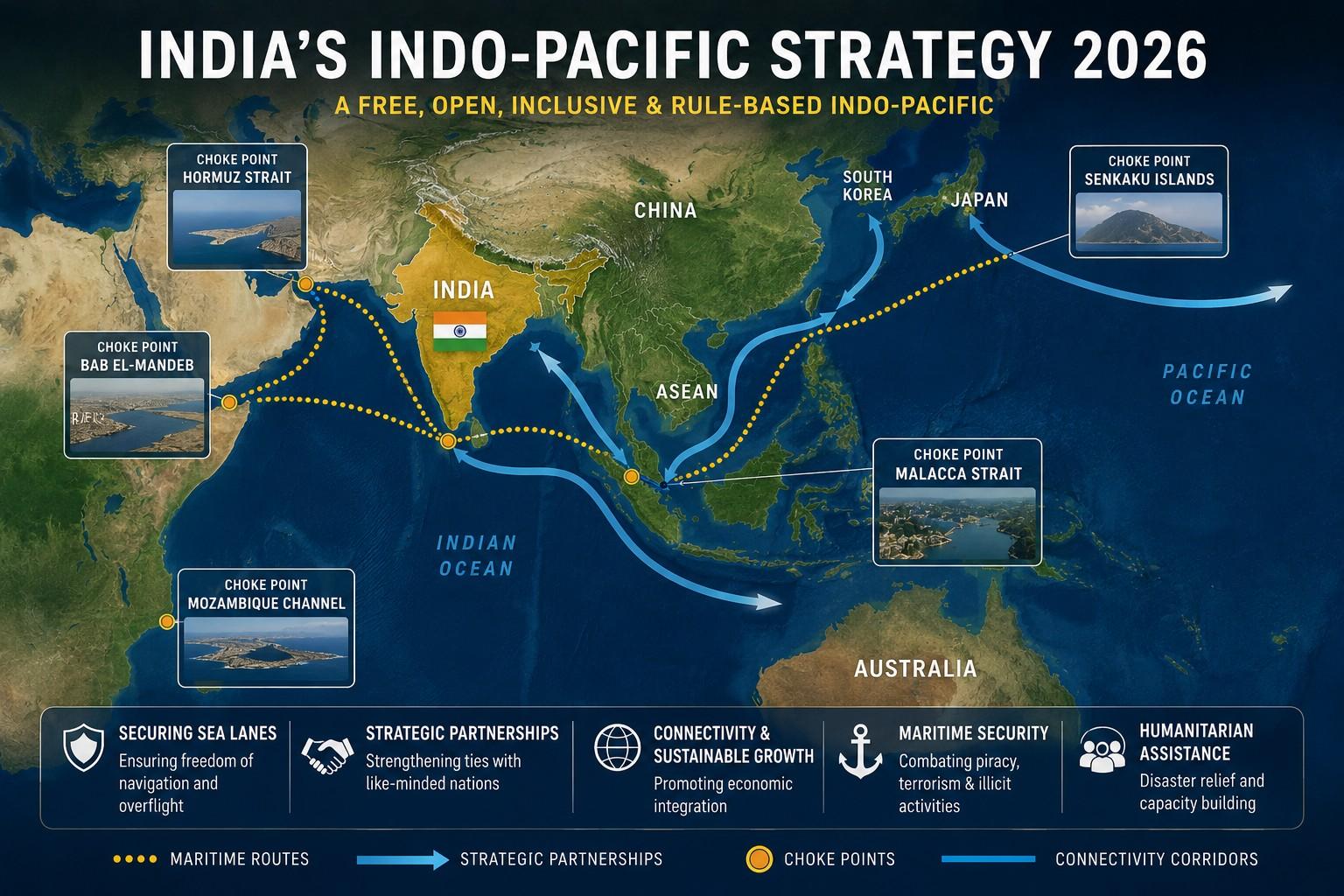
India's Indo-Pacific Strategy 2026: SAGAR, IMEC, and the New Maritime Map
Why India switched from 'Asia-Pacific' to 'Indo-Pacific', what SAGAR and IMEC actually do, and how India's maritime strategy now stretches from Mozambique to the South China Sea.
The map India put back at the centre
For four decades after 1945, the standard geographic framing of strategic Asia was "Asia-Pacific". The term came from the United States and its Pacific alliances: Japan, South Korea, the Philippines, Australia. It made sense when the central security problem was the Pacific theatre — Korea, Vietnam, Taiwan, the Soviet Pacific fleet.
In the 2010s, the framing shifted. "Indo-Pacific" entered the official vocabulary of Japan (2007, PM Abe's Two Oceans speech), the United States (2017, Trump administration's Indo-Pacific strategy), and India (PM Modi's Shangri-La Dialogue speech, June 2018).
The shift wasn't just terminological. It put the Indian Ocean — and India — back at the centre of strategic geography. Everything that has followed in Indian foreign policy in the last decade flows from that map.
SAGAR — the foundational doctrine
SAGAR ("Security and Growth for All in the Region") was announced by PM Modi during his March 2015 visit to Mauritius. The acronym is also the Hindi word for "ocean". The doctrine has five tenets:
- Safeguard India's mainland and island territories and maritime interests
- Ensure safe, secure, and stable seas for regional friends
- Promote economic and cooperative development in the region
- Tackle transnational maritime threats — piracy, terrorism, illegal fishing, trafficking — through collective action
- Sustainable use of ocean resources
In practice, SAGAR operationalised through:
- Indian Navy deployments — White Shipping Information Exchange agreements with 22 countries, where India shares maritime traffic data and gets reciprocal access
- Capacity-building — Indian Coast Guard and Navy provide training to Sri Lanka, Maldives, Mauritius, Seychelles, Mozambique, Madagascar, Comoros
- Anti-piracy patrols — Indian Navy has been continuously deployed in the Gulf of Aden since 2008, with cumulative escort of 4,500+ merchant ships
- HADR (Humanitarian Aid and Disaster Relief) — India was first responder to Sri Lanka's 2022 economic crisis, Maldives water crisis 2014, cyclones in Madagascar and Mozambique
The strategic intent: position India as the net security provider for the Indian Ocean. The doctrine is open enough to absorb future operational requirements without rewriting policy.
IMEC — the connectivity corridor
The India–Middle East–Europe Economic Corridor was announced at the G20 summit in New Delhi in September 2023. The route:
- India → UAE (by sea, primarily through Mumbai and Mundra ports)
- UAE → Saudi Arabia → Jordan → Israel (by rail)
- Israel → Europe (by sea, Haifa to Greek and Italian ports)
Members: India, UAE, Saudi Arabia, US, France, Germany, Italy, the EU. Israel is the rail terminus but not formally a signatory.
The strategic case:
- Counter-BRI: an alternative to China's Belt and Road for connecting Asia to Europe
- Faster than the Suez route by approximately 40% (rail + multi-modal)
- Energy and digital connectivity: planned hydrogen pipelines and fibre optic cables alongside the rail route
- Diplomatic re-anchoring: gives the US-aligned Gulf states a Westbound framework that doesn't depend on China
The risks:
- Post-October 2023 Israel-Hamas war disrupted the Israel rail terminus
- Houthi attacks on Red Sea shipping raise the war-risk premium on the whole corridor
- Implementation timeline — physically building rail across the Levant is a 10-15 year project at best
As of 2026, IMEC is more political framework than operational reality. The signing happened; the construction is at preliminary stages. The corridor's strategic value will mature over the next decade.
The Andaman & Nicobar Command — India's western gate
The Andaman and Nicobar archipelago — 572 islands stretching nearly 750 km in the eastern Bay of Bengal — is India's most strategically located territory. It sits at the western entrance to the Strait of Malacca, the chokepoint through which roughly 80% of China's energy imports and 50% of global trade passes.
The Andaman & Nicobar Command (ANC), established in 2001, is India's only fully tri-service joint operational command. It commands:
- INS Baaz (naval air station, Car Nicobar)
- INS Utkrosh (naval air station, Port Blair)
- INS Kohassa (naval air station, Diglipur)
- Air bases (IAF) at Port Blair, Car Nicobar, Campbell Bay
- Indian Army formations
- Coast Guard assets
The strategic premise: from Andaman & Nicobar, India can monitor — and if required, interdict — the Malacca chokepoint. The presence is the deterrent. China has historically prioritised the "Malacca Dilemma" in its strategic planning, partly because of ANC's geography.
Significant investment since 2020 has expanded runway lengths, added forward-deployed surveillance, and improved combat-aircraft basing.
Maritime partnerships — the Indian Ocean ring
India's Indian Ocean partnerships are bilateral, layered, and pragmatic.
| Partner | Cooperation pattern |
|---|---|
| Mauritius | Indian-built coast guard ships, satellite ground station, post-2014 Indian PM visit annual |
| Seychelles | Long-running coastal radar surveillance grid, training |
| Sri Lanka | Trincomalee port redevelopment with Indian Oil; coast guard cooperation |
| Maldives | Long history of cooperation, currently rebuilding post-Muizzu period |
| Mozambique | Anti-piracy training, Indian Navy ship-visits routine |
| Madagascar | Coast guard cooperation, recent HADR delivery |
| Comoros | Capacity-building bilateral |
| Tanzania | New cooperation framework 2024 |
The Indian Ocean Naval Symposium (IONS), launched by India in 2008, brings together navies of 35 Indian Ocean states for cooperation on maritime security, HADR, and capability development.
The Indian Ocean Rim Association (IORA), which India chaired in 2011-2013 and again in 2025, is the broader economic and security platform with 23 member states.
See the neighbourhood-first policy piece for the sub-regional bilateral dynamics, particularly Sri Lanka, Maldives, and Bangladesh.
What India doesn't do (and why)
Three deliberate restraints in India's Indo-Pacific strategy:
1. No South China Sea FONOPs
The US Navy regularly conducts Freedom of Navigation Operations (FONOPs) inside the 12-nautical-mile zones claimed by China around disputed South China Sea features. India does not. The Indian Navy transits the South China Sea, conducts port calls (Vietnam, Philippines, Singapore), and participates in joint exercises — but it does not challenge China's sovereignty claims through FONOPs.
The reasoning: a FONOP in the South China Sea would invite reciprocal Chinese pressure in the Indian Ocean, where India has the home advantage. The asymmetry favours restraint.
2. No troops in the South China Sea region
India has no military bases east of the Malacca Strait. The closest forward deployment is in Andaman & Nicobar (still in the Indian Ocean). India's naval reach extends to the western Pacific via Quad exercises and port calls, but no permanent presence.
3. No formal anti-China alignment
The Quad (see the Quad explainer) is explicitly framed as "for a free and open Indo-Pacific" rather than "against China". The framing is sustained partly because India insists on it.
How this connects to BRICS, the LAC, and the Russia question
India's Indo-Pacific strategy is one quadrant of a four-quadrant foreign policy:
| Quadrant | Forum | Purpose |
|---|---|---|
| Indo-Pacific maritime | Quad, IORA, BIMSTEC, IMEC | Strategic balancing + connectivity |
| Continental | LAC management, neighbourhood-first | Border security + sub-regional influence |
| Global South | BRICS, G20, Voice of Global South | Development finance + multipolarity |
| Bilateral majors | US, Russia, Israel, France, UAE | Defence tech + energy + diaspora |
For the LAC dimension, see China–India LAC tensions. For BRICS, see BRICS expansion 2026. For the Russia continued partnership, see Russia–Ukraine and India's stake.
Bottom line
India's Indo-Pacific strategy is the most consequential geographic and strategic reframing in Indian foreign policy since 1991. It places India at the centre of a maritime-strategic theatre that stretches from Mozambique to the South China Sea. It is doctrinally grounded (SAGAR), operationally backed (the Indian Navy and ANC), institutionally networked (Quad, IORA, BIMSTEC), and infrastructure-anchored (IMEC).
What it gives India: net security provider status in the Indian Ocean, strategic relevance in the Western Pacific without overextension, and a durable framework for the next several decades of Asian competition.
What it costs India: constant diplomatic management, especially of the Russia and Iran relationships that don't fit the Indo-Pacific frame naturally, and the deepening strategic competition with China that the framing implicitly encodes.
For the broader cluster, see our pieces on the Quad explained, BRICS expansion 2026, China–India LAC tensions, and India's neighbourhood-first policy.
Frequently asked questions
The Indo-Pacific is a strategic and geographic concept that treats the Indian Ocean and the Pacific Ocean as a single integrated theatre. It stretches from the east coast of Africa across the Indian Ocean, through Southeast Asia, into the Western Pacific including Japan and Australia. The framing is relatively new — adopted by Japan in 2007, by India in 2018 (PM Modi's Shangri-La speech), by the US in 2017 — and replaces the older 'Asia-Pacific' framing that put the Pacific at the centre. The shift centres India geographically and strategically.
Vikas
Founder & Editor
Founder of Bharat Sarvaseva. Writes on Indian taxes, government schemes, and citizen services with a focus on actually getting things done.
Related reading
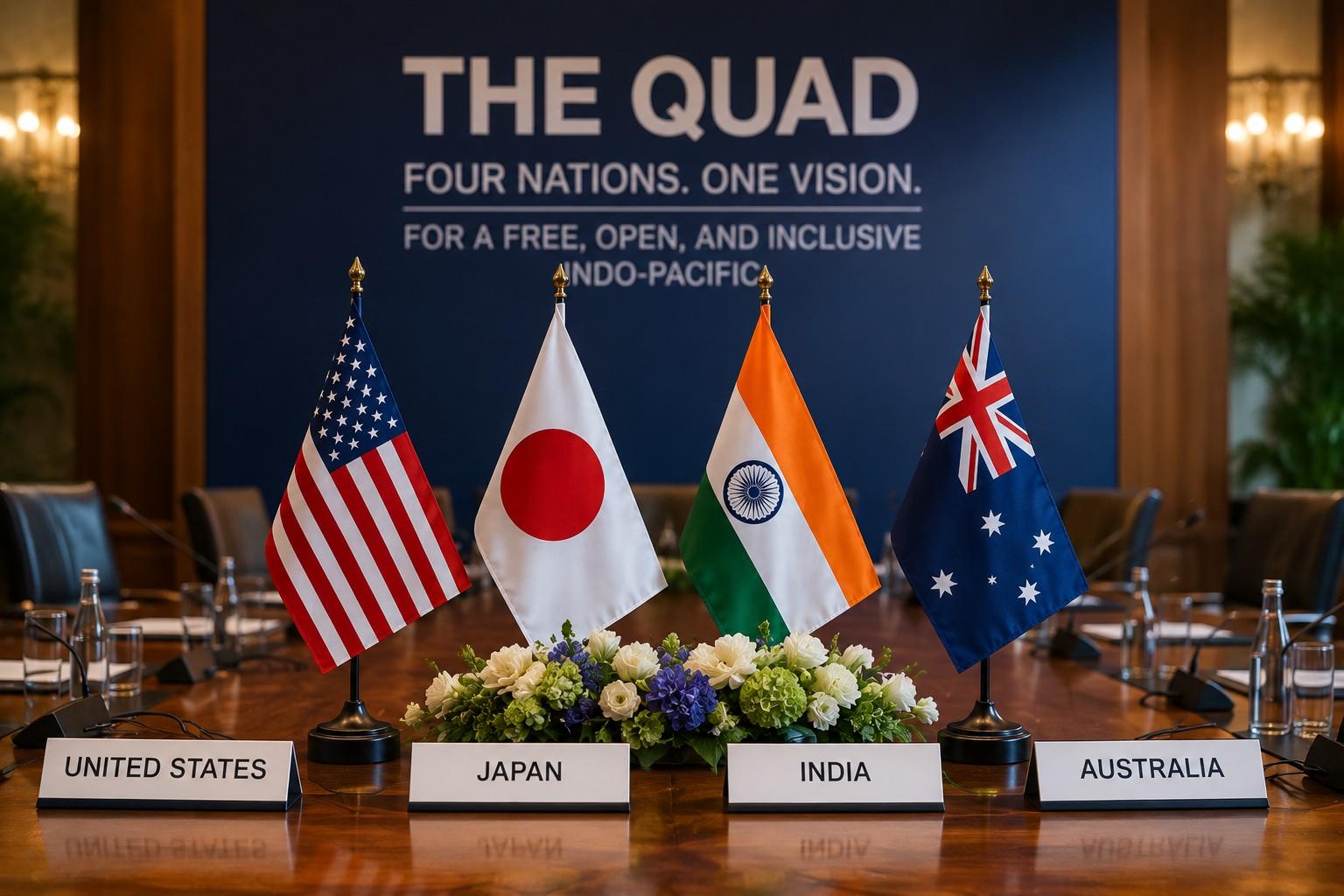
The Quad Explained 2026: What It Actually Does and Why India Joined
What the Quadrilateral Security Dialogue is, what it isn't, why India is in it despite 'strategic autonomy', and where India draws the line versus an 'Asian NATO'.
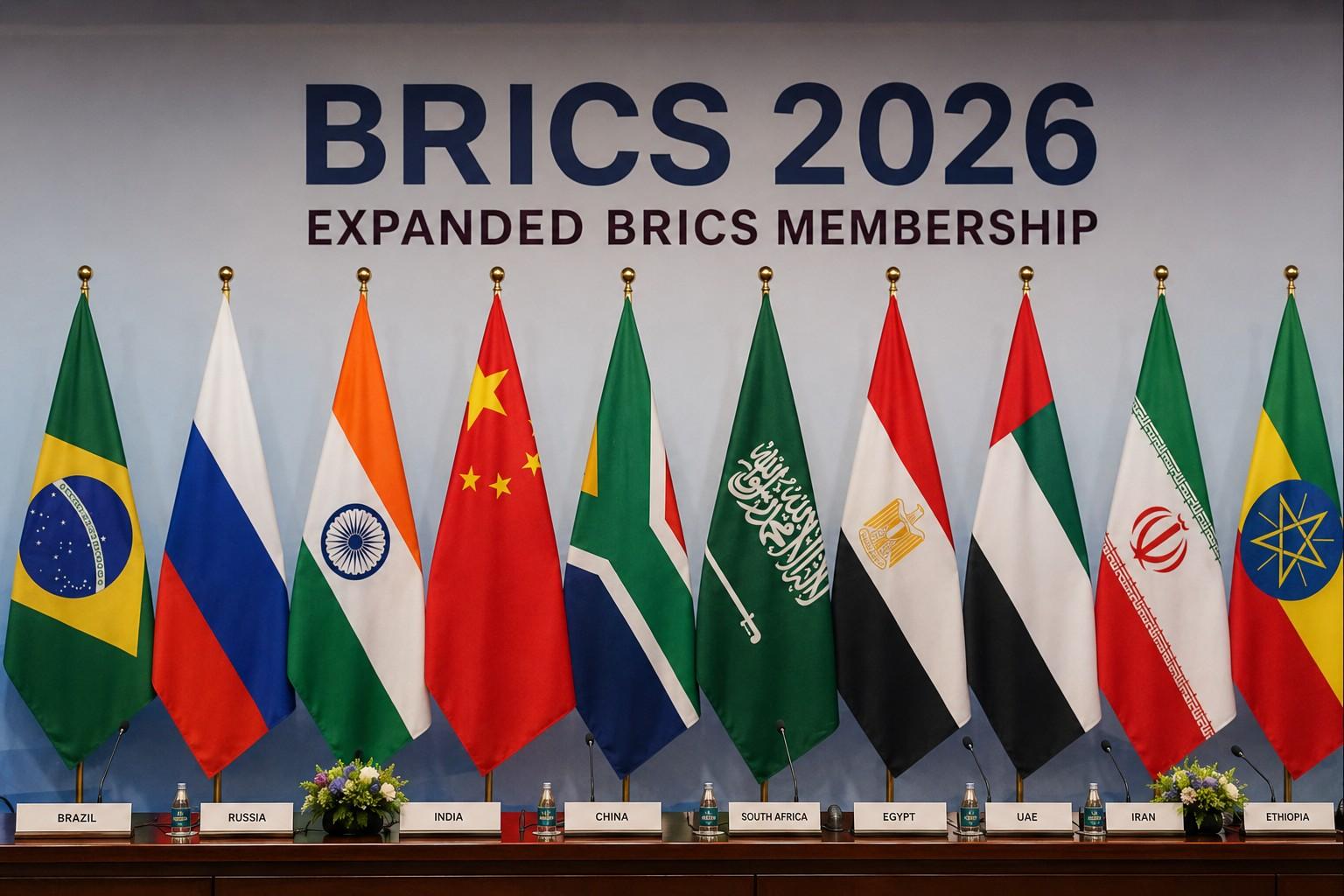
BRICS Expansion 2026: What India Actually Gets (and What It Doesn't Want)
How BRICS grew from 5 to 10+ members, why India agreed despite reservations, the 'BRICS currency' that isn't happening, and what India will and won't accept from the bloc.
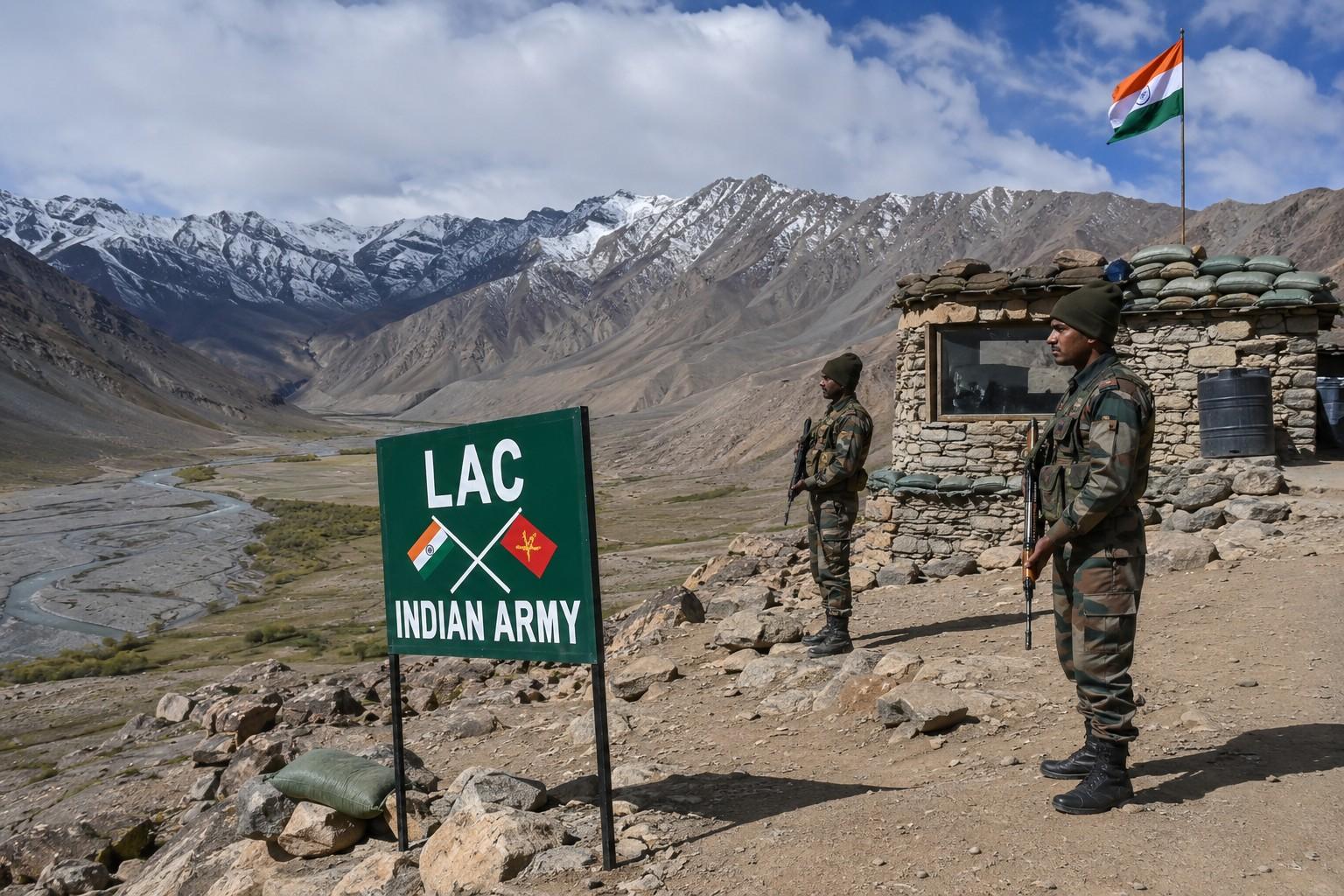
China–India LAC Tensions 2026: What's Actually Happening on the Border
Where the China–India border standoff actually stands in 2026 — the four friction points still active, disengagement vs de-escalation, and what 'managed rivalry' costs India.