Voter Registration Form 6 Online: How to Add Your Name to the Electoral Roll
Complete walkthrough of Form 6 online voter registration via the Election Commission's Voter Helpline portal — eligibility, documents, what BLO verification means, and how to track your application.
The 5-minute civic act 60% of Indians get wrong
By every recent ECI estimate, roughly 80 million eligible Indian citizens are not on the electoral roll. Some are first-time 18-year-olds who never registered. Many more are people who moved cities for work or marriage and never updated their constituency. A smaller number are stuck on multiple rolls because they registered at the new address but didn't delete the old one.
All of these are fixed by Form 6 — the standard form for adding your name to the electoral roll for a particular constituency. It takes 5 minutes online, costs nothing, and the actual barrier is knowing which form to file and what document counts as proof.
The four ECI voter forms — pick the right one
Most online articles use these interchangeably. They aren't.
| Form | What it does | Use case |
|---|---|---|
| Form 6 | New voter registration | First-time voter OR new constituency |
| Form 6A | Overseas voter registration | NRIs registering for India elections |
| Form 7 | Deletion of name | Deceased relative; OR your old entry after moving |
| Form 8 | Correction / shifting / replacement EPIC | Wrong name, address change within same constituency, photo update, EPIC reprint |
If you moved from Mumbai to Bengaluru:
- File Form 6 at your Bengaluru address (new entry)
- File Form 7 at your Mumbai address (delete old entry)
If you got married and changed your name:
- File Form 8 with marriage certificate
If you're 18 and never voted:
- File Form 6 — your only step.
Eligibility — the bare minimum
To register via Form 6, all of these must be true:
- You're an Indian citizen (or eligible OCI in some narrow cases — generally OCIs cannot vote)
- You'll be 18 years old or above by the qualifying date of the registration cycle (1 January, 1 April, 1 July, or 1 October)
- You're ordinarily resident at the address you're registering for
- You're not already registered in any other constituency (or you've filed Form 7 to delete the old one)
- You're not disqualified under law (e.g., declared of unsound mind by a competent court)
The "ordinarily resident" bit matters more than people realise:
- Working in another city for a few months ≠ ordinarily resident there
- Studying away from home for college ≠ ordinarily resident there (you remain registered at home)
- But moving with intent to stay (job + lease + new bank account) → ordinarily resident, must register at new address
Documents — what actually works
The portal lists 8-12 acceptable documents per category, but in practice these are the ones that always work:
Photo
- Passport-size photo, recent (≤ 6 months old)
- White or light-coloured background
- Face clearly visible (no glasses with glare, no headgear except religious)
- File size < 1 MB
Age proof (any one)
- Aadhaar — most common, almost always accepted
- Birth certificate (most authoritative)
- 10th class marksheet / certificate
- Passport
- PAN card
- Driving licence
- Affidavit by parent + their ID (only when none of the above are available)
Address proof (any one)
- Aadhaar with the matching address
- Passport
- Utility bill (electricity / water / gas / phone) ≤ 1 year old
- Bank passbook (with address)
- Driving licence
- Latest rental agreement (registered preferred)
- Income tax assessment
For most urban professionals, Aadhaar alone covers both age proof and address proof. That's the easiest path.
Step-by-step — Form 6 online
Step 1: Open the portal or app
- Web: voters.eci.gov.in
- App: Voter Helpline (iOS, Android — free)
Both work identically. Mobile app is slightly more polished.
Step 2: Sign up
Enter your mobile number → receive OTP → set a password. Account created.
(If you've used the portal before, just login.)
Step 3: Click Form 6
From the dashboard / "New Registration" → Form 6 — New Voter Registration.
Step 4: Fill personal details
The form is split into sections:
1. Personal info
- Name (exactly as on age proof — middle name issues cause rejection)
- DOB
- Gender
- Place of birth
- Mobile, email
2. Family info
- Parent / spouse name (whose to enter depends on your declared status)
- Their EPIC number if available (helpful — speeds up verification)
3. Address
- Full residential address with PIN code
- Choose your state, district, Assembly Constituency from dropdowns
4. Disability (optional)
- Used for accessibility planning at polling stations
5. Aadhaar (optional but recommended)
- Number + consent
Step 5: Upload documents
For each — photo, age proof, address proof:
- Click upload, pick the file
- File size < 2 MB, format JPEG / PNG / PDF
- Crop / rotate if needed (the portal has a basic editor)
Step 6: Declaration and submit
- Tick the declaration about citizenship and residence
- Acknowledge the penalty for false declaration (Section 31 of the Representation of the People Act)
- Submit
You receive a 14-digit reference number (sometimes called RN). Save it — that's your handle for tracking.
Step 7 — BLO verification (the slow part)
Within ~30 days of submission, your local Booth Level Officer (BLO) will:
- Visit your address (knock on the door, ask to see you)
- Or call your registered mobile
- Verify the documents match what you submitted
- Sometimes ask neighbours to confirm you live there
This is the single slowest step. If the BLO can't reach you (visited, nobody home, no answer to phone), the application stalls.
Speed-up tips:
- Mention your mobile number prominently in the address field
- Be available at the address for the first 4 weekends after submission
- If the BLO calls, confirm immediately and arrange a visit
- BLOs work with paper rolls — having a printed copy of your reference number helps them confirm
If 30 days pass with no contact, follow up:
- Track status on the portal — sometimes it shows "BLO assigned"
- Visit the Electoral Registration Officer (ERO) office — your tehsil or district office. They have BLO contacts.
- Call the ECI helpline 1950 for the state's roll office contact
Step 8 — Track status, download e-EPIC
Track
- Portal: voters.eci.gov.in → Track Status
- Enter 14-digit reference number → see current stage:
- Submitted → BLO not yet assigned
- BLO Assigned → field verification in progress
- Field Verification Done → BLO submitted report
- ERO Approved → you're on the roll
- EPIC Generated → digital voter ID ready
Download e-EPIC
After approval:
- Login → Download e-EPIC
- The PDF is digitally signed and accepted as voter ID for most purposes
- Physical EPIC card may take additional weeks; the e-EPIC is available immediately
- You can also collect the physical card from your BLO when ready
Common scenarios
"I'm turning 18 in 6 months — can I register now?"
Yes. The ECI accepts pre-registration for those who will reach 18 by the next qualifying date. Apply 3 months before the qualifying date (1 Jan / 1 Apr / 1 Jul / 1 Oct).
"I moved from Bengaluru to Pune for work — what do I file?"
- Form 6 for Pune (new registration)
- Form 7 for Bengaluru (deletion of old entry)
You may use a single submission flow on the portal that handles both — look for "Shifting of residence" option.
"I just got married and changed my last name"
If staying in the same constituency: Form 8 (correction). If you also moved to a new constituency: Form 6 (new registration)
- Form 7 (delete old).
"I lost my voter ID card"
- The e-EPIC is downloadable from voters.eci.gov.in for free
- For a physical replacement: Form 8 with the EPIC number / details
"I'm an NRI living abroad — can I vote?"
Yes — register via Form 6A (separate from Form 6). NRIs can vote in person at their constituency only; remote voting and proxy voting for general public NRIs is still in legislative discussion as of 2026.
Common rejection reasons
- Address proof too old (utility bill > 1 year, bank statement > 6 months)
- Photo unclear or in inappropriate format (selfie, group photo)
- Name mismatch between age proof and form (middle name, surname, alternate spellings)
- Age proof inconsistent with declared DOB
- BLO couldn't verify residence — usually because you weren't home during multiple visits
- Already registered elsewhere — you forgot to file Form 7 at the old address
Rejection reasons appear on the portal status page. Re-submission has no penalty or limit.
Why this matters even if "you don't follow politics"
Voter ID is the most widely-accepted ID for non-financial purposes in India. Beyond elections:
- It's accepted as ID at airports for domestic flights
- Banks accept it for KYC alongside Aadhaar
- It's a universal address proof for utility connections
- It's free, government-issued, and lifelong
So even if voting feels abstract, registering at your current address is one of the highest-leverage 5-minute civic acts available — and it unlocks the option to vote whenever an issue arises that you do care about.
Bottom line
Form 6 is one of the most underused, most accessible online services the Indian government runs. Most barriers are informational ("which form?", "what documents?") rather than procedural. The portal is modern, the app is smooth, and BLO verification — though slow — is field-level honest work.
If you've moved cities, it's not enough to register at the new address — also delete the old entry with Form 7. Otherwise you're on two rolls, which is technically illegal even though no one will jail you for it.
Apply at voters.eci.gov.in or via the Voter Helpline app, save your reference number, be available for BLO verification, and download your e-EPIC the moment your application is approved. That's the entire process. From submission to digital voter ID: typically 30-45 days.
For a deeper civic-education piece on how laws like the Representation of the People Act fit into Indian elections, see our Union Budget citizen's guide which walks through how parliamentary processes work.
Frequently asked questions
Form 6 is for ANY new registration at a particular address. That includes first-time voters (turning 18) AND people who moved to a new constituency. If you're already on the roll in your old constituency, you should ALSO file Form 7 to delete your old entry — otherwise you'll be on two rolls, which is illegal. Many people forget this second step.
Vikas
Founder & Editor
Founder of Bharat Sarvaseva. Writes on Indian taxes, government schemes, and citizen services with a focus on actually getting things done.
Related reading
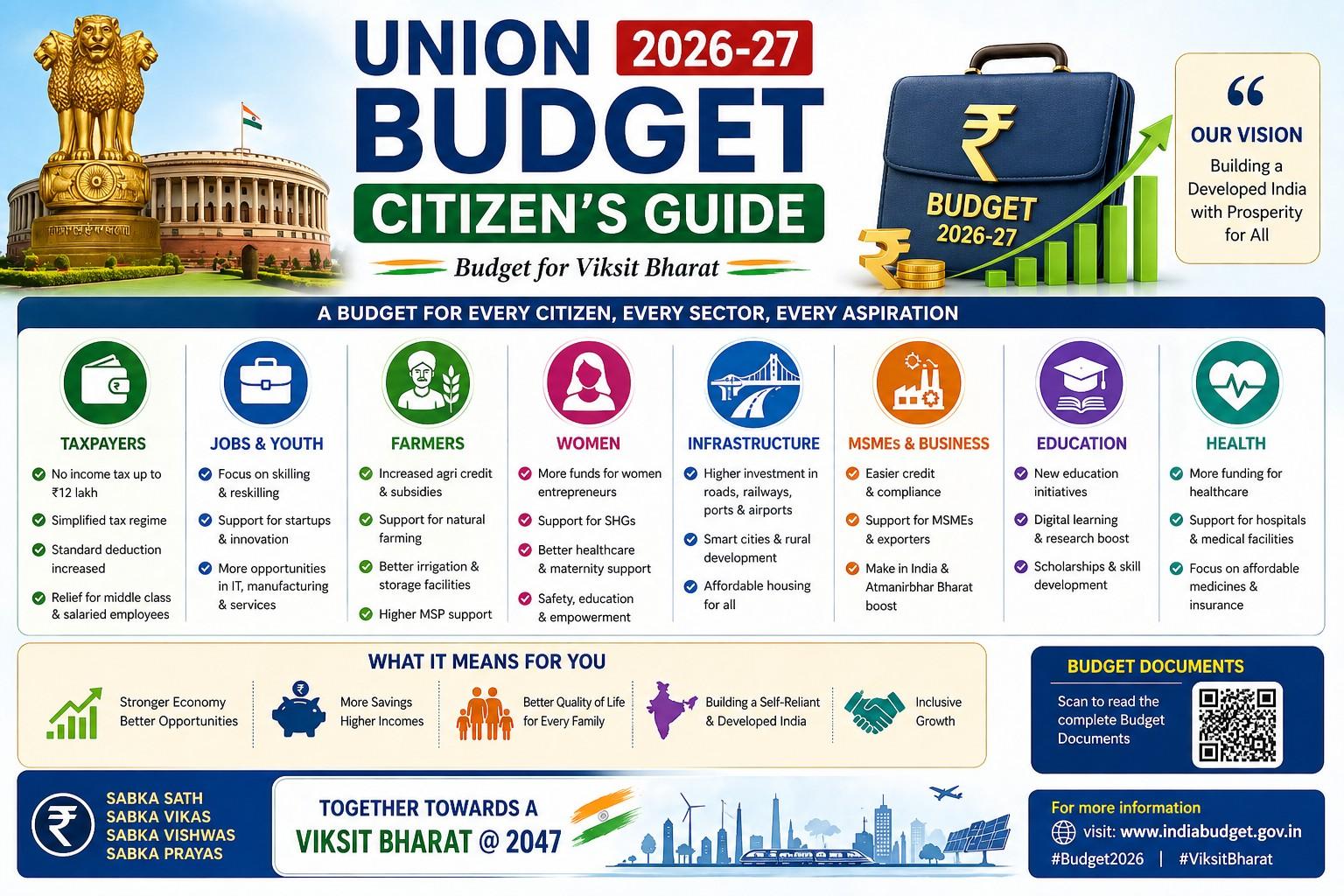
How to Read the Union Budget: A Citizen's Guide to Where Your Tax Goes
Plain-English guide to the Indian Union Budget — how it's prepared, what every section means, where your tax rupee actually goes, and how to read the numbers without getting lost.

BRICS Expansion 2026: What India Actually Gets (and What It Doesn't Want)
How BRICS grew from 5 to 10+ members, why India agreed despite reservations, the 'BRICS currency' that isn't happening, and what India will and won't accept from the bloc.

China–India LAC Tensions 2026: What's Actually Happening on the Border
Where the China–India border standoff actually stands in 2026 — the four friction points still active, disengagement vs de-escalation, and what 'managed rivalry' costs India.