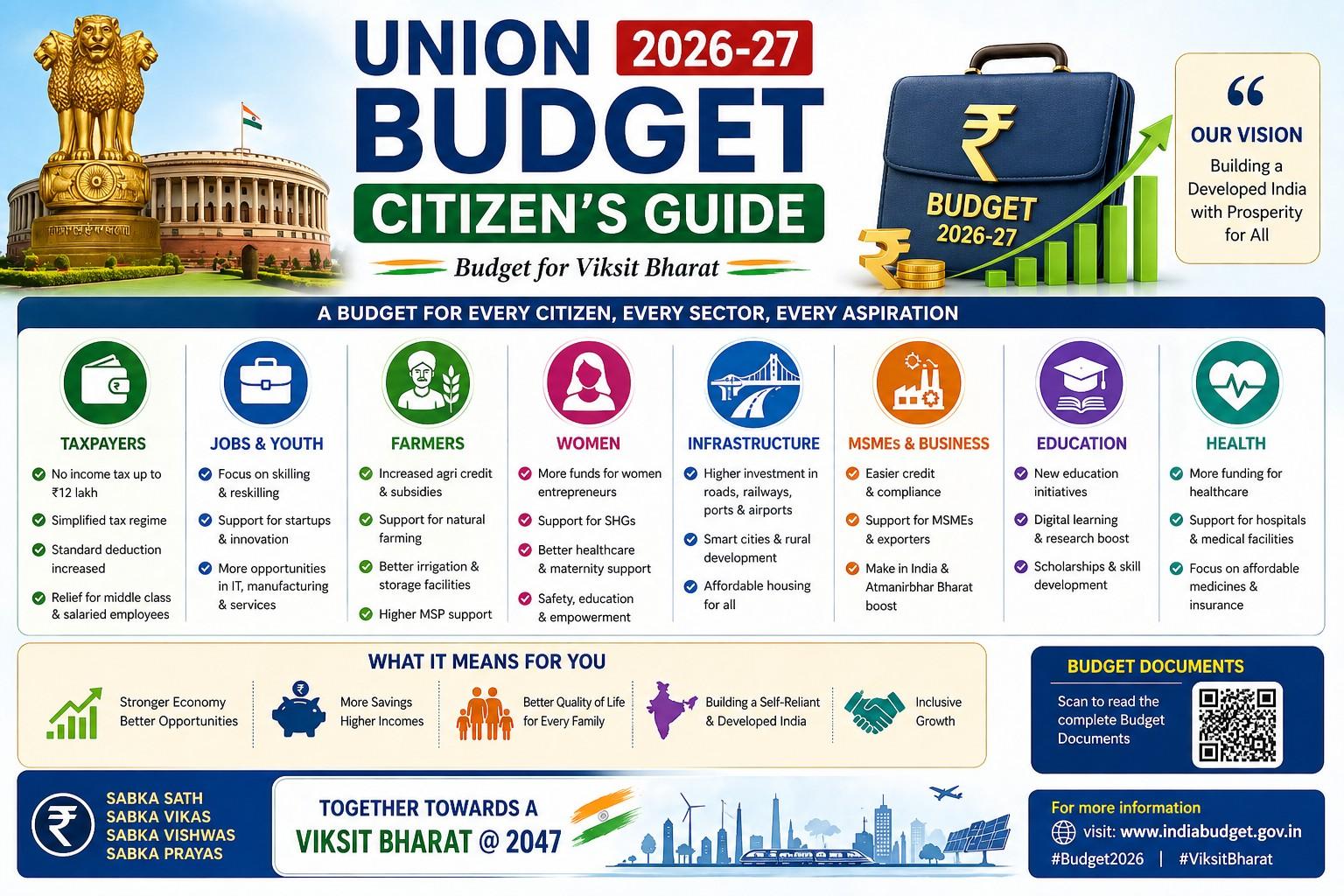
How to Read the Union Budget: A Citizen's Guide to Where Your Tax Goes
Plain-English guide to the Indian Union Budget — how it's prepared, what every section means, where your tax rupee actually goes, and how to read the numbers without getting lost.
Why this guide exists
The Union Budget is the single most important economic document India publishes each year. It's also one of the least read — partly because the PDFs are 1,000+ pages and partly because the language assumes you know what "revenue receipts net of refunds" means. This guide is written for the reader who wants to understand where ₹50 lakh crore actually goes without becoming an economist.
What the Budget actually is
Article 112 of the Constitution requires the President to lay before Parliament an Annual Financial Statement for each financial year — this is the formal name. In practice, it has three constituents:
- The Annual Financial Statement — receipts and expenditure
- The Finance Bill — tax law changes
- The Demands for Grants — department-by-department allocations
When the Finance Minister stands up on 1 February at 11 AM, all three are presented together as "The Budget".
Who prepares it
Budget preparation begins in August–September of the previous year:
- Department of Economic Affairs (DEA) in the Ministry of Finance coordinates the entire process
- Each ministry submits demands for grants by October
- NITI Aayog provides medium-term policy inputs
- The Chief Economic Adviser drafts the Economic Survey (released a day before the Budget)
- Final consolidation happens in the North Block, sealed under secrecy in late January
The traditional halwa ceremony in late January marks the start of budget printing — staff are sequestered in the basement until the speech to prevent leaks.
The structure of the Budget
Revenue Account vs Capital Account
The single most useful mental model. Both have a receipts and an expenditure side.
| Account | Receipts | Expenditure |
|---|---|---|
| Revenue | Tax + non-tax income (corporation tax, income tax, GST, excise, dividends, fees) | Salaries, pensions, interest payments, subsidies — anything used up in the year |
| Capital | Borrowings, recovery of loans, disinvestment | Assets that last more than one year — roads, schools, defence equipment, equity investments |
A simple rule: Revenue spend is the household's groceries. Capital spend is the household's car or home renovation. Capital spend creates something that produces returns; revenue spend keeps the lights on.
Receipts side — where the money comes from
Roughly, a typical year's receipt mix looks like:
| Source | Approximate share |
|---|---|
| Borrowings & other liabilities | 24–28% |
| Income tax | 18–20% |
| GST + customs | 17–19% |
| Corporation tax | 17–19% |
| Excise duty | 5–7% |
| Non-tax revenue (dividends, fees) | 9–11% |
| Disinvestment & non-debt capital | 1–3% |
Replace with actual figures from the latest Budget at a Glance.
The single biggest source — borrowing — is what powers the fiscal deficit. Every rupee borrowed is a rupee that future taxpayers will pay interest on.
Expenditure side — where it goes
The biggest line items, year after year:
| Head | Approximate share |
|---|---|
| Interest payments | 20–22% |
| States' share of taxes & duties | 18–20% |
| Centrally sponsored schemes | 9–11% |
| Defence | 8–10% |
| Subsidies (food, fertiliser, fuel) | 6–8% |
| Pensions | 4–5% |
| Major welfare schemes (PM-KISAN, MGNREGA, etc.) | 4–6% |
The uncomfortable truth: interest on past borrowings is the largest single line item. About a fifth of every rupee the government spends goes to service yesterday's debt.
Five numbers worth memorising each year
When the Budget drops, focus on these five before anything else:
- Total Receipts (excluding borrowing) — what the government genuinely earned
- Total Expenditure — what it plans to spend
- Fiscal Deficit (% of GDP) — the gap, financed by borrowing
- Capital Expenditure (% of total) — quality of the spend
- Effective Revenue Deficit — how much borrowing went to revenue spend (this is the bad kind of borrowing)
A budget where capex grows faster than revex, and fiscal deficit is trending toward the FRBM target of 4.5% of GDP, is generally considered a "growth-friendly" budget.
What the Finance Bill changes — the part that affects you
The Finance Bill carries the actual tax law amendments. Categories that typically move:
- Income Tax Slabs — old vs new regime; standard deduction; surcharge
- Capital Gains — STCG / LTCG rates, indexation, holding periods
- Section 80 deductions — usually frozen, sometimes tweaked (80C, 80D, 80G)
- GST — rate rationalisation, exemptions
- Customs duty — to make imports cheaper or dearer for specific industries (smartphones, gold, EVs, etc.)
- TDS thresholds — for small businesses and freelancers
These changes are announced in February, but most apply from 1 April of that calendar year (start of the new financial year).
How a Budget gets passed
- 1 February — Finance Minister presents Budget in Lok Sabha
- General Discussion — 4–5 days of broad debate
- Recess — Parliament breaks for Standing Committees to scrutinise ministry-wise demands
- Discussion on Demands for Grants — Lok Sabha votes on each ministry's demand
- Appropriation Bill — passed; authorises withdrawals from the Consolidated Fund of India
- Finance Bill — passed; gives effect to tax proposals
- Presidential Assent — Bill becomes Act
The whole process must conclude by 31 March. If not, a vote on account is taken to keep the lights on for a few months.
The role of the Rajya Sabha
Money Bills (and the Finance Bill, when certified as a Money Bill by the Speaker) only need Lok Sabha approval. The Rajya Sabha can discuss but not block. This is why governments with Lok Sabha majorities can pass fiscal changes even without Upper House strength.
What to read first
If you're going to read just one document, read "Budget at a Glance" — typically 25–35 pages, charts and headline numbers. Then:
- Budget Speech (~120 minutes when read aloud) — the political and thematic framing
- Receipts Budget — detailed income breakdown
- Expenditure Budget Volume 1 — programme-by-programme spend
- Demand for Grants of the ministries you care about
- Economic Survey — released the day before; gives the macro context the Budget responds to
All free at indiabudget.gov.in.
Common myths
- "The Budget changes my taxes overnight." No — most income tax changes apply from 1 April, the start of the new fiscal year.
- "GST changes happen on Budget day." Rarely. GST rates are decided by the GST Council, not the Union Budget. Customs and excise are set in the Budget.
- "The Finance Minister decides the Budget." They lead it, but the Budget is a coordinated output across the entire Ministry of Finance, RBI consultation, NITI Aayog, line ministries, and Cabinet.
- "Higher fiscal deficit is always bad." Not always — during recessions, deficit financing of capex can be growth-positive. The question is what the deficit funds, not just its size.
What the Budget can't tell you
Even a perfectly read Budget won't tell you:
- Whether the numbers will be met — actuals often diverge by 10–15%
- State-level fiscal health — that's covered by the State Budgets
- Off-budget liabilities — items routed through public sector enterprises that don't appear in the Centre's books
For these, read the CAG Reports, State Finance Commission reports, and the RBI's State Finances publication.
Bottom line
The Union Budget is a long document but a short story: how much will India earn, how much will it spend, and how much will it borrow? Five numbers tell you almost everything you need; the speech and the Finance Bill tell you what changes for you personally. Read the Budget at a Glance, learn the difference between revenue and capital, and you'll follow the next post-budget debate without anyone losing you in jargon.
Frequently asked questions
The Finance Minister presents the Union Budget on 1 February each year, except in election years when an interim 'vote on account' is presented and the full budget follows after the new government is sworn in. The fiscal year runs 1 April to 31 March.
Vikas
Founder & Editor
Founder of Bharat Sarvaseva. Writes on Indian taxes, government schemes, and citizen services with a focus on actually getting things done.
Related reading

Voter Registration Form 6 Online: How to Add Your Name to the Electoral Roll
Complete walkthrough of Form 6 online voter registration via the Election Commission's Voter Helpline portal — eligibility, documents, what BLO verification means, and how to track your application.

BRICS Expansion 2026: What India Actually Gets (and What It Doesn't Want)
How BRICS grew from 5 to 10+ members, why India agreed despite reservations, the 'BRICS currency' that isn't happening, and what India will and won't accept from the bloc.

China–India LAC Tensions 2026: What's Actually Happening on the Border
Where the China–India border standoff actually stands in 2026 — the four friction points still active, disengagement vs de-escalation, and what 'managed rivalry' costs India.