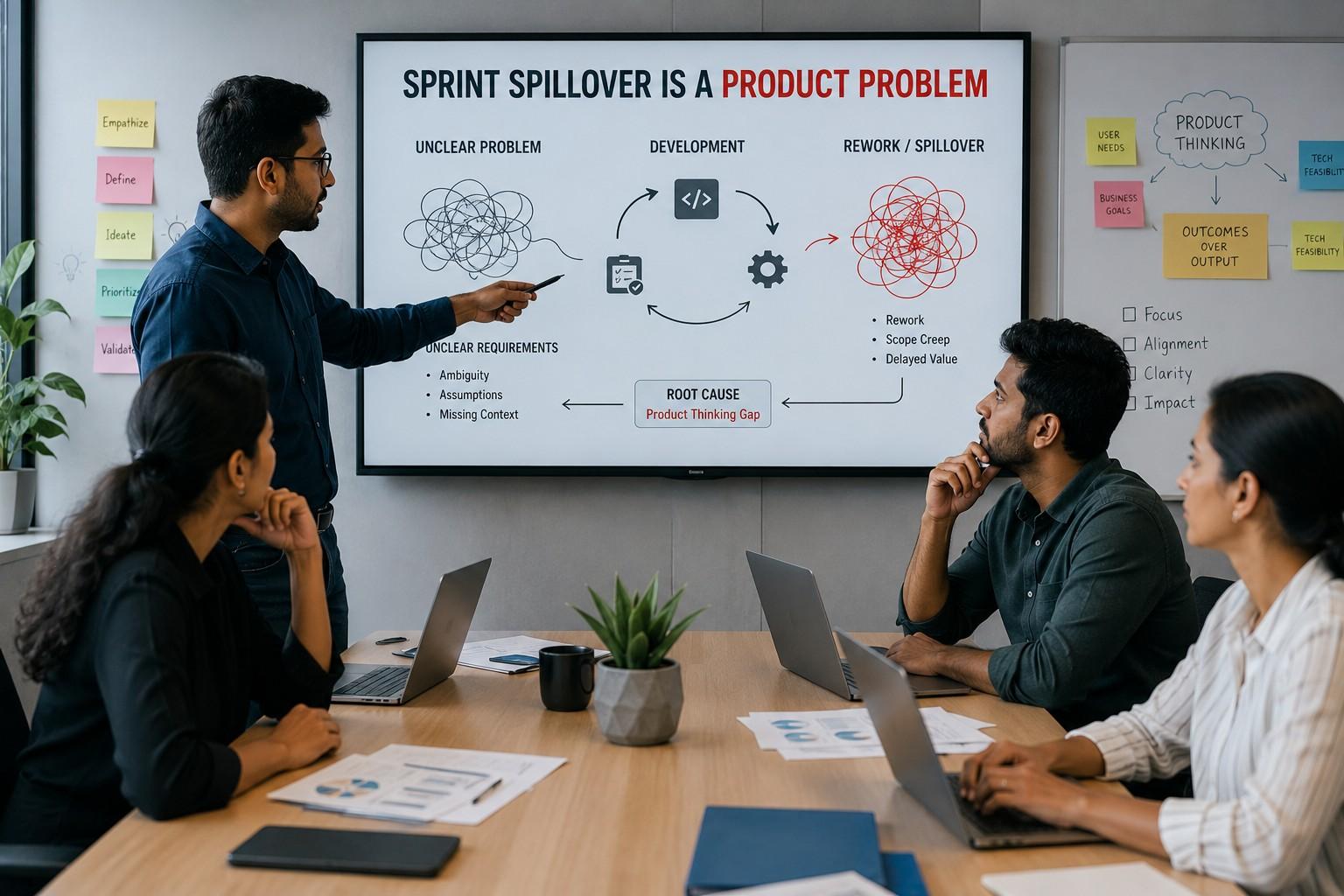
Sprint Spillover Isn't an Engineering Problem — It's a Product Problem
Why most sprint spillover traces back to product clarity failures — not engineering speed — and what AI-assisted product ownership is now changing about the math.
The reflex that's wrong
When a sprint ends with 35% of committed work unfinished, the first explanation everyone reaches for is engineering — they underestimated, they hit technical debt, they got pulled into production fires.
Sometimes that's true.
Most of the time, it's not.
Run the post-mortem deeply enough on a real sprint spillover and you almost always find the same pattern: the work was ill-specified at sprint start, the real complexity surfaced mid-sprint, requirements changed in flight, edge cases were discovered by developers (not by the product owner), or a critical non-functional requirement was missing from the story.
These are not engineering failures. They are product clarity failures that manifest as engineering delays.
The hidden math of sprint spillover
Let's break down where a "spilled" sprint's hours actually went. Aggregating across post-mortems I've seen at engineering organisations between 50 and 500 people, a sprint that delivered 65% of committed points typically spent its hours like this:
| Bucket | % of sprint hours |
|---|---|
| Net-new value creation (writing the actual feature) | 38% |
| Discovery of requirements that should have been in the story | 14% |
| Rework after mid-sprint clarification from PO / customer | 11% |
| Integration surprises (the auth flow, the data shape, the third-party API behaviour) | 9% |
| Edge cases discovered by developers | 8% |
| Production fires + unplanned incidents | 7% |
| Code review back-and-forth on unclear acceptance criteria | 6% |
| Meetings and ceremonies | 5% |
| Technical debt servicing | 2% |
Look at the top categories. Items 2 through 5 — discovery, rework, integration surprises, edge cases — make up 42% of sprint hours. These are almost entirely product-clarity costs that masquerade as engineering hours.
If your sprint delivered 65% of committed work, you didn't have a 35% engineering problem. You had a 42% product problem with a 65% engineering output.
The five product-side causes of spillover
Every spilled sprint I've examined fits one or more of these five patterns:
1. Requirements arrive in pieces
The story said "user can reset password". It didn't say:
- via email link, SMS, or both?
- what if the email is unverified?
- security-question fallback?
- session invalidation across devices on reset?
- rate limiting?
- audit log requirements?
- the password complexity policy itself?
Engineering discovers each of these mid-sprint. Each one triggers a conversation with the PO. Each conversation costs an hour and creates a 40-minute context switch on both sides. Five such discoveries in a sprint costs ten engineering hours and ten PO hours.
2. Edge cases discovered by developers, not by the PO
The classic: "what if the user's account is suspended when they try this?" The PO doesn't know. They go ask the support lead. The support lead escalates to compliance. Two days pass. The engineer either context-switches to another story or sits on a half-built feature.
This pattern repeats 3–5 times per sprint in most product organisations.
3. Non-functional requirements as afterthoughts
The story said "build the report export". It didn't say:
- export must handle 100K rows
- export must complete in under 30 seconds
- export must work in IE11 (because finance still uses it)
- export must be downloadable on mobile
- the file must be virus-scanned before download
The engineer builds for a happy-path 1,000-row case. QA finds the 100K case fails. Rework. Spillover.
4. Integration surprises that should have been mapped pre-sprint
The story said "connect to the payment provider". The PO assumed it was the same provider as the existing checkout flow. It's actually a new provider for this regional roll-out. Different API contract. Different webhook structure. Different idempotency model.
The engineer discovers this in hour 4 of the sprint. Spillover guaranteed.
5. Definition of Done that isn't
"Code committed, tests passing, PR approved." That's not actually done. Done includes: deployed to staging, regression suite green, instrumentation in place, documentation updated, feature flag configured, rollback plan documented, customer-support team briefed.
Each of those is real work. Each missing item from the DoD is a future spillover.
Why this gets blamed on engineering
Three structural reasons:
Reason 1: engineering is where "didn't finish" is visible
The story didn't ship. The engineer is the visible owner. The retrospective asks "why didn't this ship?" — and the engineer answers, with engineering vocabulary, about engineering causes.
Reason 2: most retros run engineering vocabulary
Scrum Masters are trained in engineering process. The retro template prompts: "What went well? What didn't? What can we improve?" The vocabulary of "improvement" defaults to engineering practices — testing, code review, estimation, pair programming.
There is no equivalent template prompt for "what did product clarity miss?"
Reason 3: POs participate but don't own the root cause
The PO sits in the retro, sometimes apologetically. They acknowledge that requirements were unclear. They commit to "writing better stories next time."
That commitment is sincere and almost always fails — not because the PO isn't trying, but because the underlying constraint hasn't changed. The PO still doesn't have the time, tools, or skill stack to produce the depth of specification that would actually prevent the spillover.
What AI-assisted product ownership changes
The AI shift over 2023-2026 has fundamentally changed what a product owner can produce before sprint planning. With LLM assistance + structured tools, a single PO can now produce, in a week:
- Complete user journey maps with state diagrams
- API contracts in OpenAPI format ready for engineering review
- Data model ER diagrams
- Integration sequence diagrams
- Edge case enumeration grounded in real customer support data
- Non-functional requirement specifications (latency, throughput, security)
- Threat models
- Test case catalogues
Five years ago, producing this depth required a product team plus a solution architect plus 4–6 weeks. Today, with a competent PO and AI assistance, it's a single PO and 4–6 days.
The economic consequence: the marginal cost of producing high-clarity specifications has collapsed by an order of magnitude. The right amount of specification effort has shifted accordingly.
The 42% test
Here is a simple test for any engineering organisation that suspects sprint spillover is an engineering problem:
In your next sprint retrospective, ask each engineer this single question:
"Of the hours you spent on this sprint, what percentage went to writing code that implemented the spec as it stood at sprint planning?"
If the answer is above 70%, your spillover probably is an engineering problem and you need engineering-side fixes (better estimation, smaller stories, paired programming).
If the answer is below 50%, your spillover is a product clarity problem and no amount of engineering process improvement will fix it.
Most teams I've worked with land between 35% and 55% on this question. The ones who fix it don't fix engineering. They invest in product specification depth.
What changes for the engineering team
The engineering team in an AI-assisted product organisation spends materially less time on:
- Discovering requirements mid-sprint
- Clarifying acceptance criteria
- Rework after late-discovered edge cases
- Integration surprises
- Code review debates about what the spec really meant
And materially more time on:
- Architecture validation against the spec
- Performance optimisation
- Security hardening
- Observability and operational readiness
- Production deployment automation
- Technical debt reduction
Total hours don't decrease meaningfully. The share spent on net-new value creation goes from ~38% (the typical legacy split) to ~70% in mature AI-assisted product organisations.
That ratio change — from 38% value-add to 70% value-add — is the actual productivity story. Velocity numbers might look only modestly different; delivered customer value per sprint can double.
What changes for the PO
A product owner running an AI-assisted operating model spends their week differently:
| Activity | Legacy PO | AI-assisted PO |
|---|---|---|
| Stakeholder meetings | 40% | 30% |
| Story writing | 25% | 12% |
| Backlog grooming | 10% | 6% |
| Specification depth (architecture, NFR, integration) | 5% | 35% |
| Customer interviews | 12% | 12% |
| Status / reporting | 8% | 5% |
The 30 percentage points freed by AI-assisted specification work goes directly into producing the depth that engineering needs to start sprints without unknowns.
This is what the Product Owner's new job actually looks like.
What this means for engineering leaders
Three concrete actions:
-
Run the 42% test on your next sprint. If your team's answer is below 50%, you have a product clarity problem, not an engineering one.
-
Re-scope the PO role to include 30%+ of working time on specification depth. Hire or train accordingly. This is not "asking the PO to do more"; it's redirecting the time that's currently lost to spillover-causing under-specification.
-
Move retrospective ownership for spillover to the PO + engineering manager jointly. The PO's accountability for spec depth has to be made visible in the same forum that judges engineering performance.
Bottom line
Most sprint spillover is a product problem. Engineering process improvements — better estimation, smaller stories, more refinement — will not fix it. They address symptoms.
What fixes it is product specification depth that AI-assisted tooling now makes economically feasible at a per-PO scale. The next decade's high-performing engineering organisations will be the ones whose product owners learned to operate this new operating model.
For the role redefinition this implies, see our companion piece: The Product Owner's New Job: Engineering Orchestration.
Question for product leaders, engineering managers, and CTOs reading this: in your last sprint retrospective, did the "what didn't go well" section attribute spillover to engineering or to product? And if it was engineering — was it really?
Frequently asked questions
Sprint spillover is the work committed in a sprint that doesn't get completed and rolls over into the next sprint. Industry studies put average spillover rates at 20–35% of committed story points across mature Agile teams. Most retrospectives attribute spillover to engineering causes — underestimation, complexity, technical debt — but a deeper analysis usually shows that 50–70% of spilled work traces back to product-side clarity failures: ambiguous requirements, edge cases discovered mid-sprint, missing non-functional requirements, and integration surprises that should have been mapped before the sprint started.
Vikas
Founder & Editor
Founder of Bharat Sarvaseva. Writes on Indian taxes, government schemes, and citizen services with a focus on actually getting things done.
Related reading

The Product Owner's New Job: Engineering Orchestration
Why the product owner role is evolving from requirement gathering to engineering orchestration — the six new artefacts AI-assisted POs now produce, and what this means for hiring.

DigiLocker Complete Guide 2026: How to Stop Carrying Documents
How DigiLocker actually works in 2026 — issuing documents, sharing them, what's legally accepted, the verification API, and the things most users get wrong.

ONDC Explained 2026: Will It Actually Replace Amazon and Swiggy?
What ONDC actually is, why the government built a 'UPI for commerce', what it costs sellers and buyers, and the realistic answer to whether it will displace Amazon and Swiggy.