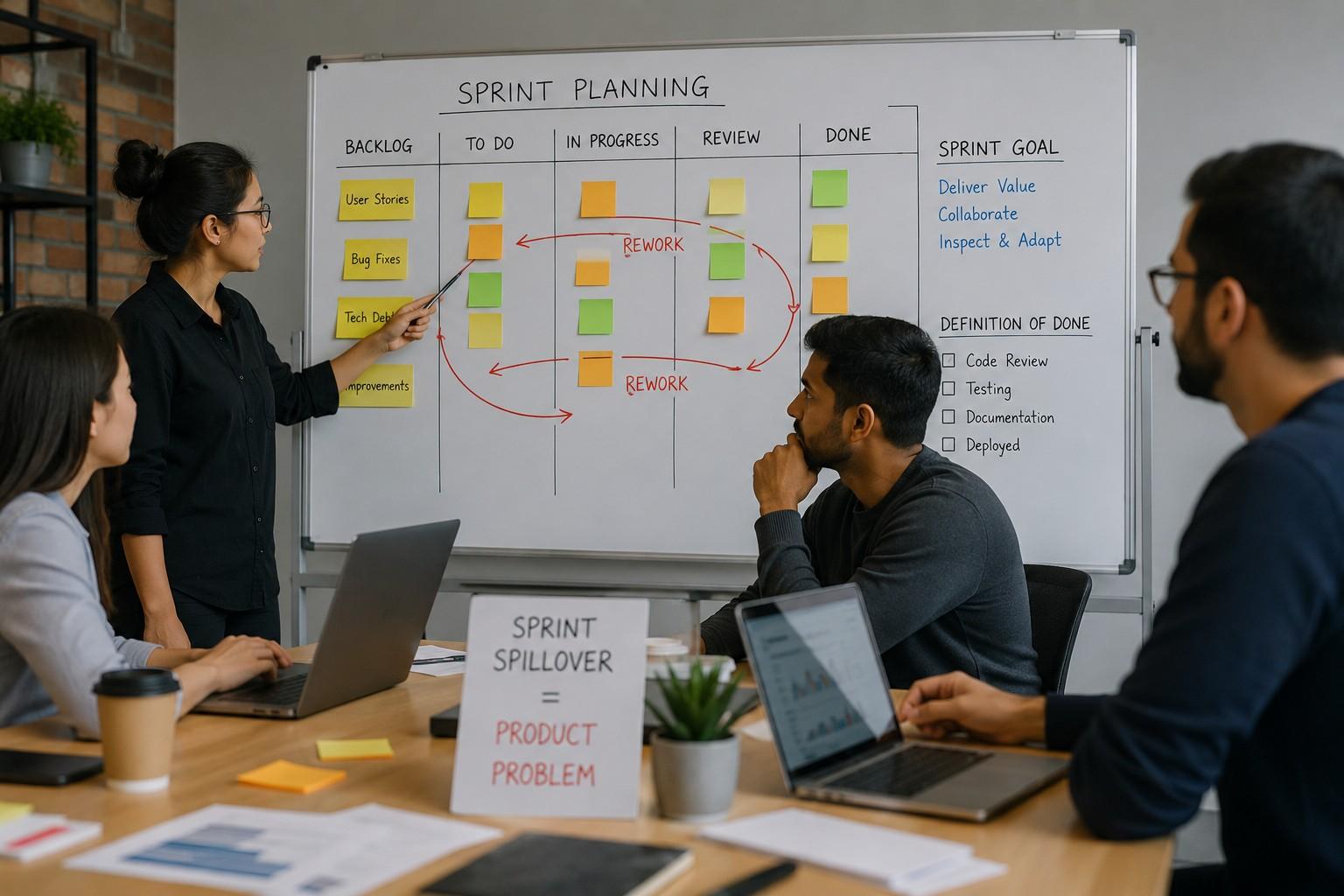
The Product Owner's New Job: Engineering Orchestration
Why the product owner role is evolving from requirement gathering to engineering orchestration — the six new artefacts AI-assisted POs now produce, and what this means for hiring.
The job is changing faster than the job description
For the last 15 years, the product owner job has had a stable definition: talk to customers, translate their needs into user stories, prioritise the backlog, support the engineering team during sprints.
That definition is becoming obsolete.
In 2026, the highest-performing product organisations have product owners doing something materially different. They produce — before sprint planning — the kind of technical artefacts that engineering teams historically discovered or built during the sprint. They specify systems to architecture depth. They model integration flows. They write API contracts. They enumerate edge cases. They specify non-functional requirements.
The label that captures this is engineering orchestration. The PO is not writing production code. They are specifying the system to a point where engineering's job is implementation and validation, not discovery.
This is a role redefinition, not an extension. And it has implications for hiring, for career paths, and for how engineering teams operate.
What the old PO job looked like
For 15 years, the product owner role had four pillars:
| Pillar | Time share | Typical artefact |
|---|---|---|
| Stakeholder management | 40% | Meeting notes, status decks |
| User story writing | 25% | Jira tickets with acceptance criteria |
| Backlog grooming and prioritisation | 10% | Backlog ranking |
| Sprint support + UAT | 25% | Clarifications, demos, sign-offs |
The PO talked to customers. They translated needs into stories. They groomed the backlog. They supported engineering during execution.
What they did NOT typically produce:
- System context diagrams
- API contracts
- Data models
- Integration sequence diagrams
- Detailed non-functional requirement specifications
- Edge case catalogues at architecture depth
- Security threat models
Those artefacts, when they existed at all, were produced by solution architects, senior engineers, or technical product managers. Most organisations produced them inconsistently or skipped them entirely. The result, as we discussed in sprint spillover is a product problem, was 35–42% of sprint hours spent on discovering what should have been specified upfront.
What the new PO job looks like
The same four pillars exist, but the time distribution has shifted:
| Pillar | Old time share | New time share | What changed |
|---|---|---|---|
| Stakeholder management | 40% | 30% | Fewer "clarification" meetings because specs are clearer |
| User story writing | 25% | 12% | Stories are shorter because the spec is in attached artefacts |
| Backlog grooming | 10% | 6% | Faster because priorities are clearer at the artefact level |
| Specification depth (NEW) | 5% | 35% | The new core of the job |
| Sprint support | 20% | 17% | Less needed because engineering starts with fewer unknowns |
The 30 percentage points freed from stakeholder management and story writing flow into the new specification-depth pillar. This is the job redefinition.
The six artefacts the new PO produces
What does "specification depth" actually mean? Six artefacts, each producible in 1-2 days with AI assistance, that historically required either weeks of solution architect time or were never produced at all:
1. System context diagram
Shows the system and its boundaries — what's inside, what's outside, what external systems it integrates with, what users interact with it. C4 notation, Mermaid syntax, or PlantUML — the format matters less than the fact that it exists at sprint-planning time.
2. API contracts in OpenAPI
For every endpoint that will be built or modified in the sprint, an OpenAPI 3.x specification with request/response schemas, error codes, and authentication patterns. The PO produces these with LLM assistance from the user story; the engineer reviews and either accepts or proposes modifications.
3. Data model (ER diagrams)
The entities, attributes, relationships, and constraints. Database-agnostic at first; engineering refines to the chosen database during implementation. Critically, this surfaces data-shape questions before sprint, not during.
4. Integration sequence diagrams
For each external integration the story touches, a sequence diagram showing the call flow, error paths, timeout handling, and retry strategy. The PO doesn't decide implementation details; they specify the desired behaviour at architecture level.
5. Non-functional requirements
A structured NFR specification for each story: latency targets, throughput expectations, availability requirements, security constraints (data classification, encryption at rest/in transit), compliance touchpoints, accessibility requirements, observability needs.
6. Edge case catalogue + threat model
For each story, an enumeration of edge cases (the "what if the user...?" cases) plus a lightweight threat model (STRIDE-style). The PO does this with AI assistance grounded in real customer support data and domain-specific threat patterns.
Each of these six artefacts is something a senior engineer or solution architect would historically produce — or discover during the sprint. Producing them upfront, with AI assistance, at PO-level cost, is the core competitive shift.
What stays human
Three things the AI-assisted PO does that AI alone cannot:
1. Customer empathy and judgment
Talking to actual customers. Reading between the lines of what they say. Identifying which 3 of the 30 expressed needs are the real underlying problem. This is irreplaceably human and is the foundation of everything else.
2. Prioritisation under uncertainty
Choosing between feature A and feature B when both have plausible upside. This requires judgment about business strategy, competitive landscape, team capacity, and organisational politics. AI assists by structuring trade-offs; it does not make the call.
3. Stakeholder management and political navigation
The CFO, the head of sales, the regulator, the support lead, the senior engineer with strong opinions — managing this web is human work. AI helps with preparation and synthesis; it doesn't replace the conversation.
What stays engineering
Five things engineering uniquely does, in this operating model:
- Architecture validation — accepting or modifying the PO's draft architecture artefacts based on production realities
- Implementation — writing the actual code, with all the judgment that implementation requires
- Performance optimisation — finding and fixing real-world bottlenecks
- Security hardening — translating threat models into actual defensive code
- Operational excellence — deployment, observability, incident response, rollback
The total engineering hours required to ship a product don't decrease meaningfully in this model. The share spent on net-new value creation goes from ~38% to ~70%, because hours previously spent on discovery and rework now go to the high-leverage work engineering does best.
The skills inventory for the next-gen PO
What does a PO need to know to do this job? My working list, after talking to ~30 high-performing AI-assisted product organisations:
Technical depth (the big shift)
- Architecture patterns: monolith vs microservices vs modular monolith, event-driven vs synchronous, REST vs GraphQL vs gRPC
- System design fundamentals: load balancing, caching, queues, databases (relational vs document vs graph), CAP theorem at intuition level
- API design: REST conventions, versioning, error handling, pagination, webhook patterns
- Data modelling: ER design, normalisation, indexing implications
- Security fundamentals: AuthN/AuthZ, OAuth/OIDC, JWT, common vulnerability classes (OWASP Top 10), encryption at rest/in transit
- Observability: structured logging, metrics, tracing, SLI/SLO/SLA
AI-assisted production skills
- Prompt engineering for specification artefacts
- LLM tool ecosystem — Claude, GPT-4/5, Gemini, specialised architecture-diagram tools
- Diagram-as-code — Mermaid, PlantUML, C4-PlantUML, draw.io
- OpenAPI authoring — comfortable with YAML / JSON spec syntax
Domain depth (unchanged)
- Deep knowledge of the customer, the problem, the competitive landscape
- Business model fluency
- Prioritisation frameworks
Collaboration (unchanged)
- Stakeholder management
- Cross-functional facilitation
- Conflict navigation
The skills inventory has expanded by about 40% on the technical side. The business and human sides are unchanged. The job is harder, more technical, and more leverage-able — all simultaneously.
What this means for hiring
If you are hiring a senior PO in 2026, the job description is changing. Old PO job descriptions ("translates customer needs into stories, manages backlog, supports engineering") will not attract the candidates who can operate this new model.
Better PO job descriptions in 2026 read more like:
Senior Product Owner — AI-Assisted Product Engineering
You will own the customer journey for [product area]. You will produce — with AI assistance and in collaboration with engineering — the system context, API contracts, data models, integration designs, and NFR specifications that enable engineering to start each sprint without unknowns. You will not write production code; you will specify systems to architecture depth. You will hold a technical conversation with senior engineers as a peer.
Background: 5+ years in product, with at least 2 in a strongly technical domain. Comfortable producing OpenAPI specs, ER diagrams, sequence diagrams. Fluent with at least one LLM-based product specification workflow. Customer-empathy track record demonstrated by specific examples.
Compensation has to match. In US tech companies in 2026, this senior PO role typically pays 15-30% above the legacy senior PO band, often overlapping with senior engineering manager bands.
What about junior POs and associate PMs?
The junior PO and APM role still exists and is essential. It's where new POs learn the customer-empathy, prioritisation, and stakeholder muscles that don't change. Junior POs will spend their first 2-3 years building those foundations.
The expectation in 2026 and beyond: by the time a PO reaches senior level, they should be operating the AI-assisted engineering-orchestration model. The PO who stays at the legacy "stories and backlog" depth into year 5 is career-stuck.
The 5-year forecast
Three predictions for 2026-2031:
1. The PO role splits into two tracks
A junior / IC track (customer empathy, story writing, backlog) and a senior / leadership track (engineering orchestration, architecture, system design). Career progression requires crossing the technical-depth bridge.
2. Solution architect headcount peaks and slowly declines
Not because architecture work disappears, but because the first-draft work that SAs historically did shifts to AI-assisted POs. SAs become fewer, more senior, more focused on validation and complex-system design.
3. Engineering leadership rebalances toward fewer, more senior engineers
If the engineering team spends 70% of its time on net-new value creation (vs the legacy 38%), the productivity per engineer roughly doubles. Engineering org sizes adjust accordingly — fewer junior engineers, more senior engineers, flatter structures.
What you should do if you're a PO reading this
Three concrete steps:
-
Take a system design course. Designing Data-Intensive Applications (Kleppmann), the Grokking System Design series, or your company's internal engineering curriculum. You need this foundation.
-
Pick one feature in your next sprint and produce all six artefacts for it. OpenAPI, ER diagram, sequence diagram, NFRs, edge cases, threat model. Use AI assistance. Submit it to your senior engineer for review.
-
Ask your engineering manager to score that artefact bundle on a 1–10 scale for clarity and completeness. Their feedback is your leading indicator of where you are in the transition.
This will be uncomfortable. The first artefact bundle you produce will be inadequate. The fifth will be passable. The fifteenth will be indistinguishable from a senior SA's work, at a tenth the cost.
That is the skill curve you're starting.
Bottom line
The product owner role is in the middle of the biggest redefinition since the role was formalised in the Agile Manifesto era. AI-assisted product ownership is not "doing the old job faster." It's a substantively different job with different artefacts, different skills, and different career economics.
The POs who make the transition will define the next decade of product work. The organisations that hire them will ship faster. The engineers they work with will spend more time on the work engineering loves.
Everyone else will be wondering why sprints still spill over.
For the companion analysis on why this matters operationally, see Sprint Spillover Is a Product Problem.
Question for product leaders and engineering managers reading this: of your current senior POs, how many could produce six architecture artefacts for a feature this week, with AI assistance, to a standard your senior engineers would accept? If the answer is fewer than half, what is your plan?
Frequently asked questions
Engineering orchestration is the practice of producing — before sprint planning — the technical artefacts that engineering teams traditionally discovered or built during the sprint itself. Specifically: system context diagrams, API contracts in OpenAPI format, data models, integration sequence diagrams, non-functional requirement specifications, edge case enumeration, and security threat models. The PO doesn't write the production code; they specify the system to the point where engineering's job is implementation and validation, not discovery.
Vikas
Founder & Editor
Founder of Bharat Sarvaseva. Writes on Indian taxes, government schemes, and citizen services with a focus on actually getting things done.
Related reading
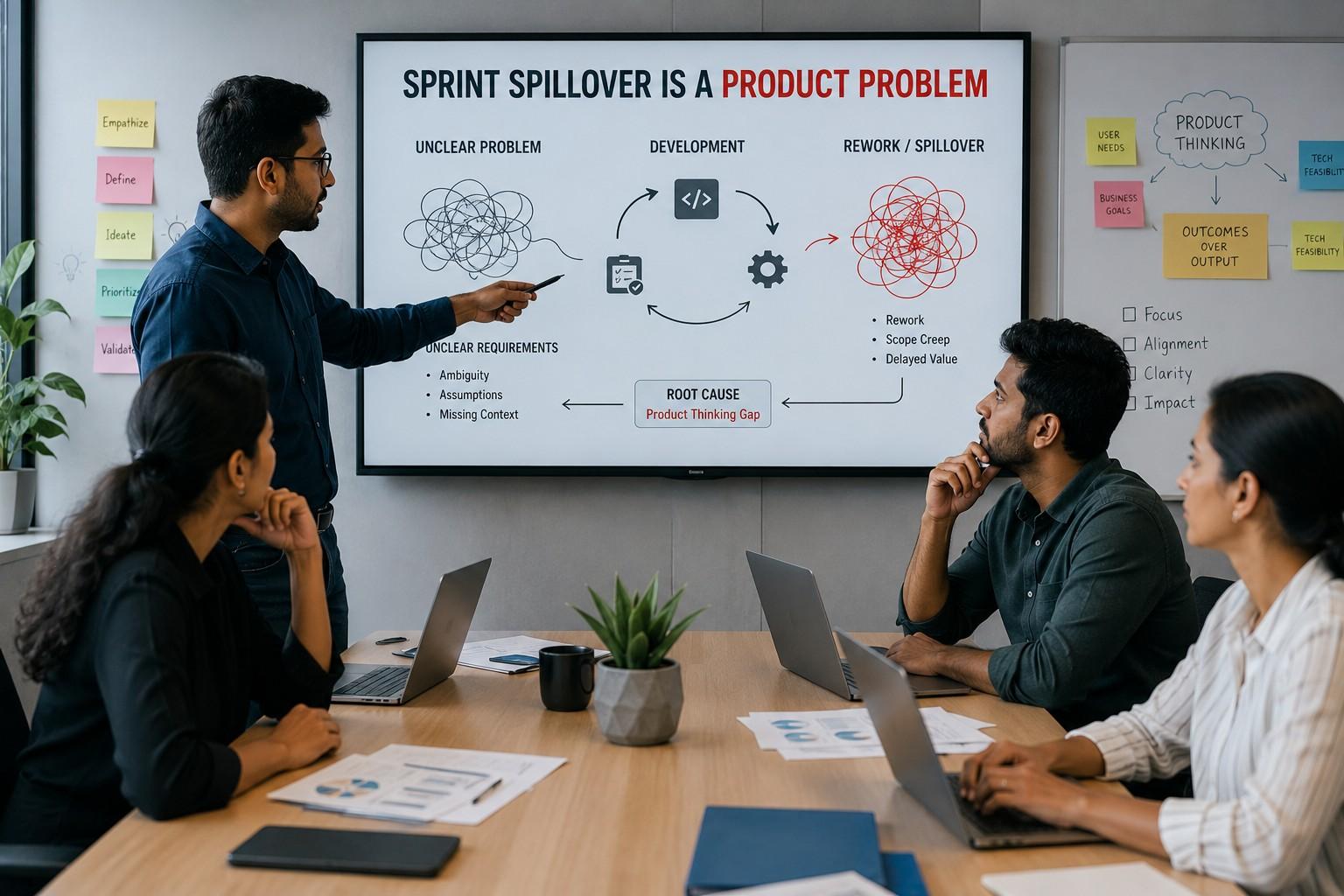
Sprint Spillover Isn't an Engineering Problem — It's a Product Problem
Why most sprint spillover traces back to product clarity failures — not engineering speed — and what AI-assisted product ownership is now changing about the math.

DigiLocker Complete Guide 2026: How to Stop Carrying Documents
How DigiLocker actually works in 2026 — issuing documents, sharing them, what's legally accepted, the verification API, and the things most users get wrong.

ONDC Explained 2026: Will It Actually Replace Amazon and Swiggy?
What ONDC actually is, why the government built a 'UPI for commerce', what it costs sellers and buyers, and the realistic answer to whether it will displace Amazon and Swiggy.