
ONDC Explained 2026: Will It Actually Replace Amazon and Swiggy?
What ONDC actually is, why the government built a 'UPI for commerce', what it costs sellers and buyers, and the realistic answer to whether it will displace Amazon and Swiggy.
What problem ONDC tries to solve
In 2026, three companies — Amazon, Flipkart, and Reliance — control about 80% of organised e-commerce in India. Two — Swiggy and Zomato — control about 95% of food delivery. Each runs a closed network: their app, their sellers, their delivery, their pricing power.
Closed networks have two well-documented problems:
- High take rates. Swiggy and Zomato take 18–30% commission from restaurants. Amazon takes 8–25% depending on category, plus advertising fees. These costs flow back to consumers.
- Discoverability monopoly. A new restaurant in Indore depends on Swiggy ranking it; a new seller depends on Amazon's Buy Box algorithm. The platform decides who gets seen.
ONDC — the Open Network for Digital Commerce — is the government's answer. It's designed to do for commerce what UPI did for payments: break the walled gardens by mandating an open protocol that anyone can plug into.
How ONDC actually works
The architecture is three layers:
1. Buyer-side apps
These are apps where you, the customer, browse and order. Currently:
- Paytm — biggest by volume
- MagicPin — strong in food delivery
- PhonePe Pincode — Walmart-backed
- Mystore — generalist
- Bank apps (HDFC, Axis, etc.) integrating ONDC into their apps
- Government apps (some state apps)
2. The ONDC protocol layer
A set of specifications — like UPI's NPCI specs — that define how apps exchange messages. Search request, search response, order confirmation, payment confirmation, shipping update. ONDC itself is a Section 8 (non-profit) company, not a commercial entity.
3. Seller-side apps
These onboard merchants — restaurants, kirana stores, brand websites, small e-commerce. Examples:
- MagicPin Seller (food)
- eSamudaay (kirana groceries)
- GoFrugal (retail POS-integrated)
- Storeking (rural)
- Dunzo for Business (hyperlocal)
A seller registered with one of these is automatically discoverable by all buyer apps in the network.
Why prices are lower
The cost stack is dramatically different:
| Cost layer | Swiggy/Zomato | ONDC |
|---|---|---|
| Network commission | 18–30% | 1–3% |
| Buyer-app commission | included above | 0.5–2% |
| Seller-app commission | included above | 1–4% |
| Logistics | 8–15% | 5–12% |
| Total platform take | 25–40% | 8–18% |
The 15–22 percentage points of savings in the take-rate gap is the central economic story. It can flow into:
- Lower retail prices (typical for groceries, partial for food)
- Higher restaurant/seller margins
- Better delivery wages (sometimes)
Where ONDC works well
After three years of operation, the categories where ONDC has earned a real foothold:
Food delivery in tier-2/3 cities
In smaller cities where Swiggy/Zomato presence is thin and restaurants are price-sensitive, ONDC has captured 15–25% of delivery volume in places like Indore, Coimbatore, Lucknow, and Vizag. The thinner competition means even ONDC's smaller catalogue covers most relevant restaurants.
Kirana groceries
The most under-told ONDC success: small kirana stores selling staples and FMCG via ONDC's grocery flows. The ₹3,000–8,000 crore monthly volume here is genuinely incremental commerce — much of it would not have happened on Amazon or BigBasket.
Government and B2B procurement
State governments in Karnataka, Maharashtra, and Tamil Nadu have mandated ONDC for certain procurement classes. Some PSUs use it for employee meal-vouchers. This is small in absolute terms but high-margin and reliable.
Where it falls apart
Fashion and apparel
Closed-platform brand pages (Myntra, Ajio) are essential discovery infrastructure for fashion. ONDC's catalogue depth is too thin and the return-handling too inconsistent for fashion to work yet.
Electronics and big-ticket
Brand warranty, installation, and trust signals matter enormously. Amazon's Buy Box reliability and Flipkart's Plus services are hard to replicate via a network of independent sellers.
Premium urban food delivery
Where Swiggy One and Zomato Gold members get free delivery, fast service, and reliable apps, ONDC's variance frustrates power users. Top-25% urban food-delivery customers stick with closed platforms.
Realistic expectations for 2027–2030
The honest answer to "will ONDC replace Amazon and Swiggy" is no — not in any reasonable horizon. The realistic outcome:
- Amazon, Flipkart, Swiggy, Zomato continue to dominate premium urban categories — fashion, electronics, restaurant delivery to ₹10K+/month households
- ONDC captures 15–30% share in food delivery, groceries, kirana, and government procurement
- Some seller-side apps become large (eSamudaay, MagicPin) but no buyer-side app becomes a Swiggy-killer
- Closed platforms partially open up because ONDC participation becomes a regulatory expectation — Reliance Jio Mart and Dunzo already do this
ONDC's actual win is the existence of a credible exit option for sellers. A restaurant tired of 28% Swiggy commissions can plausibly list on ONDC instead. That bargaining-leverage value is real even if ONDC stays a smaller second-place network.
What you should do
As a customer:
- Try Paytm or MagicPin for food delivery for one week. See if your go-to restaurants are listed and whether prices are lower.
- For groceries in non-metros, MyStore and eSamudaay can be 10–25% cheaper than BigBasket on staples.
As a seller:
- ONDC is worth listing on as a second sales channel — the marginal cost of being on the network is small via apps like MagicPin or eSamudaay. Don't kill your Swiggy listing; just add ONDC.
As a developer:
- The ONDC network protocol is fully open and the Buyer App / Seller App reference implementations are on GitHub. There's a real green field for vertical-specific apps (B2B textiles, ag-inputs, etc.) that don't have giant incumbents.
Bottom line
ONDC is the most ambitious open-network commerce project in the world, and it's working — at smaller scale than the hype, but real. It's not going to replace Amazon. It's going to limit Amazon's pricing power and create infrastructure that millions of small Indian businesses can plug into without giving away 30% of their margin.
For more on India's open-stack approach to digital infrastructure, see our DigiLocker complete guide.
Frequently asked questions
ONDC is a government-backed protocol that lets any buyer app talk to any seller app. Today, if you order biryani on Swiggy, only Swiggy's restaurants show up. With ONDC, a 'buyer app' (could be Paytm, MagicPin, or your bank's app) can show you restaurants from any 'seller app' (could be a small restaurant aggregator's local network) — like UPI lets any bank's app pay any other bank's UPI ID.
Vikas
Founder & Editor
Founder of Bharat Sarvaseva. Writes on Indian taxes, government schemes, and citizen services with a focus on actually getting things done.
Related reading
The Product Owner's New Job: Engineering Orchestration
Why the product owner role is evolving from requirement gathering to engineering orchestration — the six new artefacts AI-assisted POs now produce, and what this means for hiring.
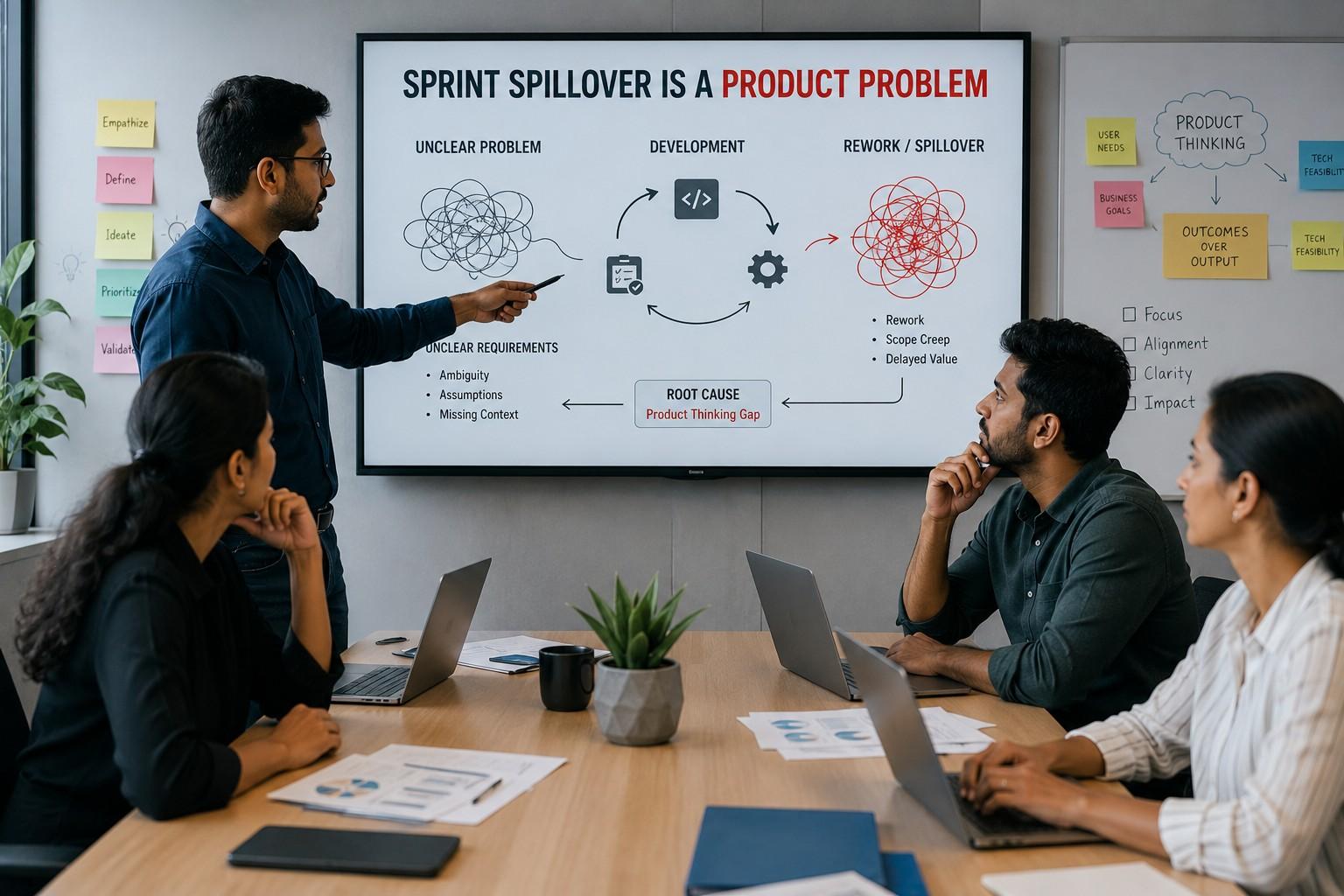
Sprint Spillover Isn't an Engineering Problem — It's a Product Problem
Why most sprint spillover traces back to product clarity failures — not engineering speed — and what AI-assisted product ownership is now changing about the math.

DigiLocker Complete Guide 2026: How to Stop Carrying Documents
How DigiLocker actually works in 2026 — issuing documents, sharing them, what's legally accepted, the verification API, and the things most users get wrong.