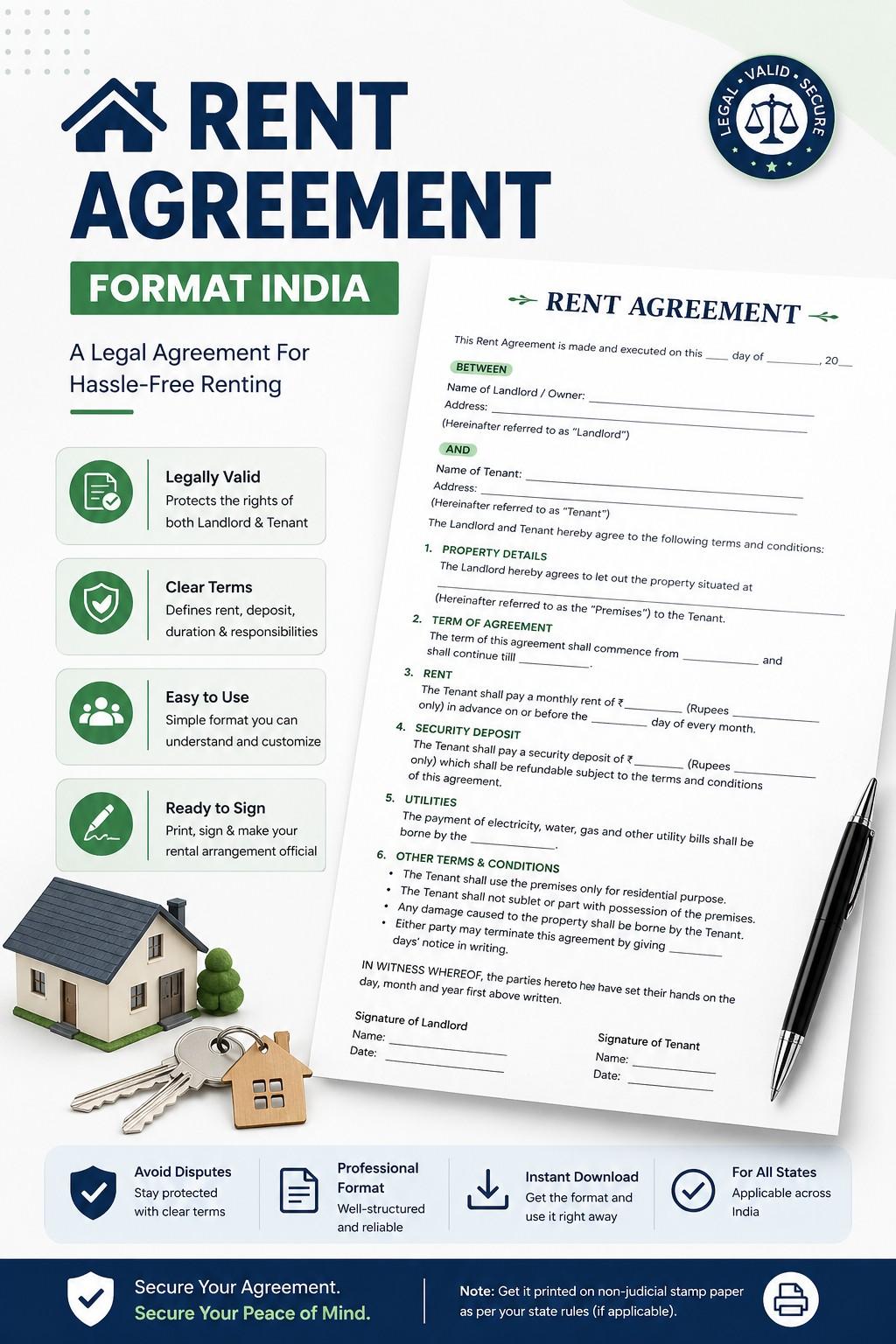
Rent Agreement Format India: Free Template + Stamp Duty by State
Free, lawyer-vetted rent agreement format for India with stamp duty rates by state, registration rules, and the 11-month vs 12-month tenancy explained.
Why this guide exists
Most landlord–tenant disputes in India trace back to a vague or missing rent agreement. A clean, properly stamped agreement protects both sides — and it takes about 30 minutes to set up if you know the moves.
What a rent agreement should contain
Every rent agreement in India should clearly state:
- Parties — full names, parents’ names, ages, addresses, PAN numbers
- Property — full address, area in sq ft, furnished status
- Term — start date, end date, renewal terms
- Rent and deposit — monthly rent, security deposit, payment date, mode
- Maintenance — who pays society maintenance, electricity, water, internet
- Restrictions — pets, subletting, alterations, working from home
- Notice period — typically 1–2 months from either side
- Lock-in period — minimum stay, usually 6 months for 11-month leases
- Witnesses — two adult witnesses with addresses and signatures
11-month vs 12-month: which to choose
The 11-month agreement is the default for residential tenancies because it falls outside the Registration Act, 1908’s compulsory-registration trigger. Registration adds 1% of the annual rent (often capped) plus paperwork at the Sub-Registrar office. For an 11-month term, you only pay state stamp duty.
For commercial leases, long-term family arrangements, or tenancies above ₹50 lakh annual rent, register the agreement regardless.
Stamp duty by state (placeholder)
Replace with verified current rates from each state’s Stamp Act before publishing.
| State | Stamp Duty (residential, 11 months) | Registration |
|---|---|---|
| Maharashtra | 0.25% of total rent + deposit | Optional |
| Karnataka | ₹100–₹500 (notarised) | Optional |
| Delhi | ₹100 stamp paper | Optional |
| Tamil Nadu | 1% of total rent | Optional |
| Telangana | 0.5% of annual rent | Optional |
How to execute the agreement
- Draft the agreement using the template below.
- Buy non-judicial stamp paper of the correct value (or use e-stamping in states like Karnataka, Maharashtra, Delhi).
- Print the agreement on the stamp paper or attach the e-stamp certificate.
- Both parties sign every page; two witnesses sign at the end.
- Get it notarised by a notary public (₹100–₹300).
- Each party keeps one signed original.
Free 11-month rent agreement template
RENT AGREEMENT

This Rent Agreement is made on this _____ day of __________, 20__ at __________
between:

Mr./Ms. ____________________________________ (LANDLORD), aged ___ years,
S/o or D/o __________________________, residing at __________________________
(hereinafter called the "Landlord", which expression shall include heirs,
successors, etc.) of the ONE PART;

AND

Mr./Ms. ____________________________________ (TENANT), aged ___ years,
S/o or D/o __________________________, residing at __________________________
(hereinafter called the "Tenant") of the OTHER PART.

WHEREAS the Landlord is the absolute owner of the property situated at
____________________________________________________________ (the "Premises").

WHEREAS the Tenant has approached the Landlord to take the Premises on rent
and the Landlord has agreed to let out the Premises on the terms below:

1. TERM. The tenancy is for a period of 11 (eleven) months commencing from
   _________ and ending on _________.

2. RENT. The Tenant shall pay a monthly rent of Rs. __________ (Rupees ______
   only) on or before the 5th of each English calendar month.

3. SECURITY DEPOSIT. The Tenant has paid an interest-free refundable deposit
   of Rs. __________ (Rupees __________ only) by ____________ (cheque/UPI),
   refundable on vacating the Premises after deducting any lawful dues.

4. UTILITIES. Electricity, water, gas, and internet charges shall be paid by
   the Tenant directly. Society maintenance shall be borne by the Landlord
   unless agreed otherwise.

5. USE. The Premises shall be used for residential purpose only. The Tenant
   shall not sublet, assign, or part with possession.

6. ALTERATIONS. The Tenant shall not make any structural alteration. Minor
   fittings may be installed with written consent of the Landlord.

7. NOTICE. Either party may terminate this Agreement by giving 1 (one) month
   written notice. A lock-in of 6 months applies, during which the Tenant
   shall pay rent for the remaining lock-in period if vacating early.

8. INSPECTION. The Landlord may inspect the Premises with 24-hour prior
   notice during reasonable hours.

9. RENEWAL. The Agreement may be renewed by mutual consent with a rent
   escalation not exceeding ___% per annum.

10. JURISDICTION. Disputes shall be subject to the courts at __________.

IN WITNESS WHEREOF, the parties have signed this Agreement on the date
mentioned above in the presence of:

LANDLORD                                 TENANT
__________________                       __________________
[Signature]                              [Signature]

WITNESSES:
1. Name: ____________ Address: ____________ Signature: ____________
2. Name: ____________ Address: ____________ Signature: ____________
Common mistakes to avoid
- Skipping the lock-in clause — landlords who skip this lose 1–2 months’ rent if a tenant moves out early.
- Mismatched deposit amount — write the deposit in both figures and words.
- Missing PAN of landlord — without PAN, the tenant cannot claim HRA above ₹1 lakh annual rent.
- No inventory list for furnished flats — attach a signed inventory; it prevents end-of-tenancy disputes over fixtures.
What about online rent agreements?
E-stamping portals (Karnataka, Delhi, Maharashtra, etc.) and platforms like NoBroker and LegalDesk let you generate, stamp, and notarise an agreement in under an hour for ₹500–₹1,500. They are legally valid as long as the stamp duty is correct.
Next steps
After signing, share a copy with your society secretary and update the police tenant verification form — mandatory in many states. If you’re about to claim HRA, also collect your landlord’s PAN.
Frequently asked questions
Yes. An 11-month tenancy agreement is fully valid and is the most commonly used format because tenancies under 12 months are generally exempt from compulsory registration under the Registration Act, 1908 — saving registration cost and time.
Vikas
Founder & Editor
Founder of Bharat Sarvaseva. Writes on Indian taxes, government schemes, and citizen services with a focus on actually getting things done.
Related reading

Gift Deed vs Will: Which Is Better for Property Transfer in India?
The ₹4 lakh mistake most Indian parents make when transferring property to children — gift deed vs will compared on cost, tax, control, and disputes.

BRICS Expansion 2026: What India Actually Gets (and What It Doesn't Want)
How BRICS grew from 5 to 10+ members, why India agreed despite reservations, the 'BRICS currency' that isn't happening, and what India will and won't accept from the bloc.

China–India LAC Tensions 2026: What's Actually Happening on the Border
Where the China–India border standoff actually stands in 2026 — the four friction points still active, disengagement vs de-escalation, and what 'managed rivalry' costs India.