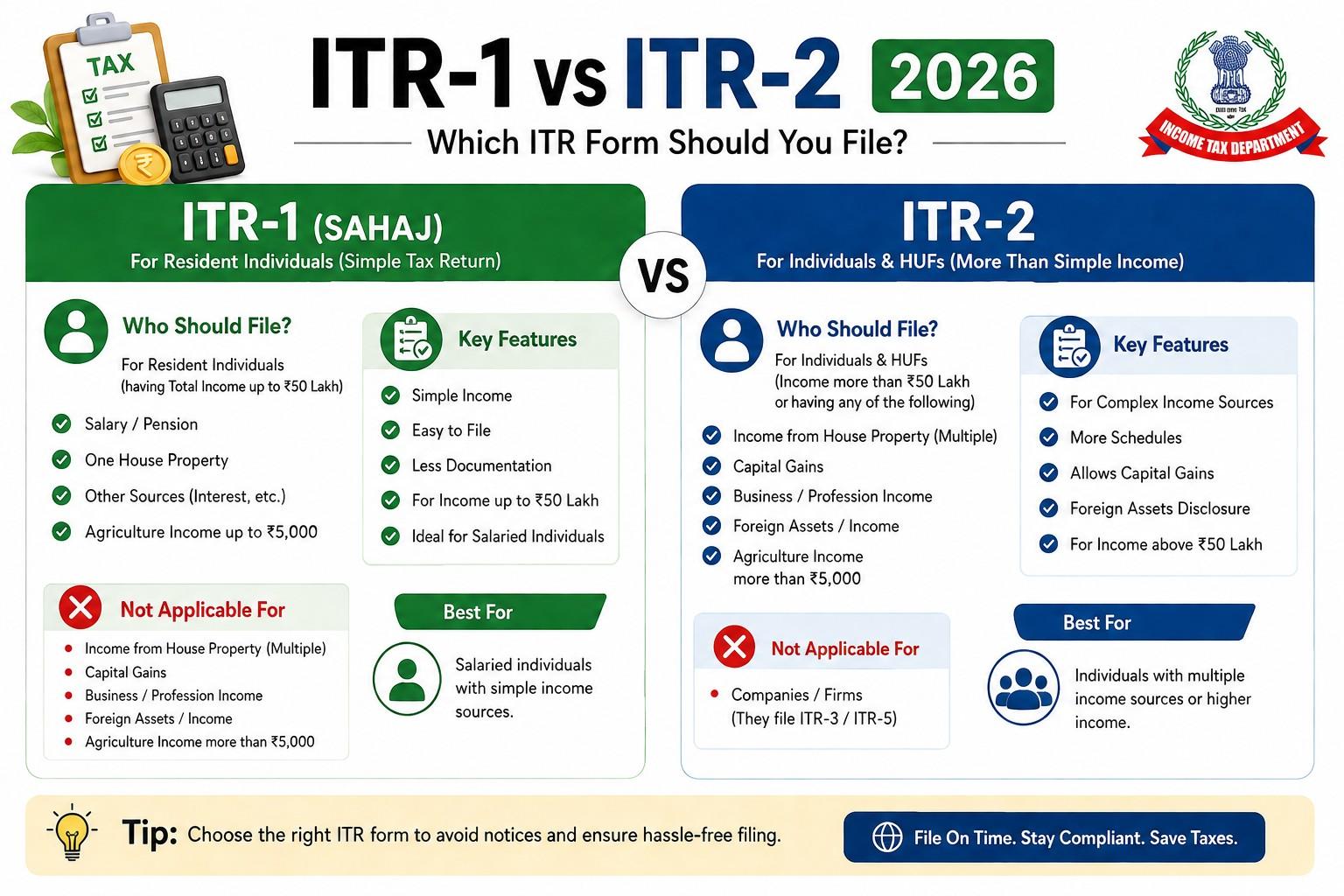
ITR-1 vs ITR-2: Which One Should You File in 2026?
60-second decision tree for choosing between ITR-1 (Sahaj) and ITR-2 for FY 2025-26 — income limits, who qualifies, what disqualifies you, and common filing mistakes.
The 60-second answer
If you are a salaried Indian resident, earn under ₹50 lakh, own at most one house, and have no capital gains or foreign income — file ITR-1 (Sahaj). Anything else, file ITR-2.
Why this question matters
Filing the wrong ITR form is the single most common mistake on the income tax portal. The system accepts the return, but the assessment can be reopened later for "defective return" under Section 139(9). You then have 15 days to fix it or the return is treated as never filed — meaning late fees, interest, and lost refunds.
Who qualifies for ITR-1 (Sahaj)
ITR-1 is meant for resident individuals with simple, salary-style income. You can use ITR-1 only if all of these are true:
- You are a resident individual (not RNOR, not NRI)
- Total income for the year is up to ₹50 lakh
- Income comes from any combination of:
- Salary or pension
- One house property (self-occupied or let out)
- Other sources (interest, dividend, family pension)
- Agricultural income is up to ₹5,000
What disqualifies you from ITR-1
You cannot use ITR-1 — and must use ITR-2 — if any of the following apply:
- You have any capital gains (shares, mutual funds, property, crypto)
- You own more than one house
- You are a director in a company
- You hold unlisted equity shares
- You have foreign income or foreign assets
- You are an NRI or RNOR
- Total income exceeds ₹50 lakh
- You have agricultural income above ₹5,000
- You have brought-forward losses or want to carry forward losses
- You have TDS deducted under Section 194N (cash withdrawal above ₹1 crore)
If any one of these is true, file ITR-2.
Who should use ITR-2
ITR-2 is for individuals and HUFs with no income from a business or profession, but with anything more complex than ITR-1 covers. Common ITR-2 filers:
- Salaried with stock or mutual fund capital gains
- People who sold property during the year
- NRIs with India-source income
- Owners of multiple houses
- Anyone with foreign salary, foreign bank accounts, or foreign assets
- High earners above ₹50 lakh
Quick decision tree
- Do you earn from a business or profession? → File ITR-3 (out of scope here)
- Are you an NRI or RNOR? → ITR-2
- Do you have any capital gains, foreign income, or foreign assets? → ITR-2
- Total income above ₹50 lakh? → ITR-2
- Own more than one house? → ITR-2
- Director in a company or holding unlisted shares? → ITR-2
- Otherwise — ITR-1 (Sahaj)
Documents you'll need
Whether you file ITR-1 or ITR-2, keep these handy before you start:
- Form 16 from your employer (salary + TDS)
- AIS / TIS download from the income tax portal
- Form 26AS for TDS reconciliation
- Bank interest certificate and savings account statements
- Aadhaar (for OTP-based e-verification)
- PAN
- Capital gains statements (broker P&L, mutual fund SOA) — ITR-2 only
- Sale deed and indexed cost for property sale — ITR-2 only
- Foreign asset details — ITR-2 NRI/RNOR only
- Home loan interest certificate (Section 24b)
- Section 80C / 80D / 80G receipts (old regime only)
Old vs new tax regime
From AY 2024-25, the new tax regime is the default. You must explicitly opt for the old regime in the return — and salaried filers can switch between old and new every year (business owners cannot). Decide based on your deductions:
- Old regime is better if your deductions (80C, 80D, HRA, home loan interest, NPS, etc.) add up to roughly ₹3.5–4 lakh or more
- New regime is better if you take few deductions or are early in your career
A simple rule: if you contribute ₹1.5 lakh to 80C, ₹50k to NPS, ₹25k to 80D, get HRA, and pay home loan interest — old regime usually wins. Otherwise, new regime.
Common filing mistakes
- Picking ITR-1 with capital gains — even ₹100 of short-term gain pushes you to ITR-2
- Forgetting AIS reconciliation — pre-fill is helpful but not always complete; check AIS for hidden interest, dividend, and SFT transactions
- Skipping Schedule FA in ITR-2 — disclose foreign assets even if no income; non-disclosure attracts penalty under Black Money Act
- Wrong bank account for refund — must be pre-validated and primary
- Not e-verifying within 30 days — return becomes invalid
- Old regime opted by mistake — if you intended new but ticked the wrong box, file a revised return before deadline
Deadlines for FY 2025-26 (AY 2026-27)
Replace with the latest notified deadlines before publishing.
| Filer type | Original due date | Belated last date |
|---|---|---|
| Individuals (no audit) | 31 July 2026 | 31 December 2026 |
| Individuals (audit cases) | 31 October 2026 | 31 December 2026 |
| Revised return | — | 31 December 2026 |
Late fee under 234F: ₹5,000 (₹1,000 if total income below ₹5 lakh) plus interest under 234A on unpaid tax.
Bottom line
If your tax life is salary + maybe some bank interest + one house — ITR-1 takes 15 minutes on the portal. Add anything else, and ITR-2 is the right form. Wrong form is a defective return, so when in doubt, go ITR-2 — it covers everything ITR-1 does, plus more.
Filing is free on incometax.gov.in. Paid platforms (Cleartax, Quicko, TaxBuddy) help if your capital gains statements need parsing or you want audit-trail support — useful for first-time ITR-2 filers.
Frequently asked questions
No. The moment you have any capital gain — listed shares, mutual funds, property — you are pushed to ITR-2. Even a small ₹500 short-term gain on a stock you sold disqualifies you from ITR-1.
Vikas
Founder & Editor
Founder of Bharat Sarvaseva. Writes on Indian taxes, government schemes, and citizen services with a focus on actually getting things done.
Related reading
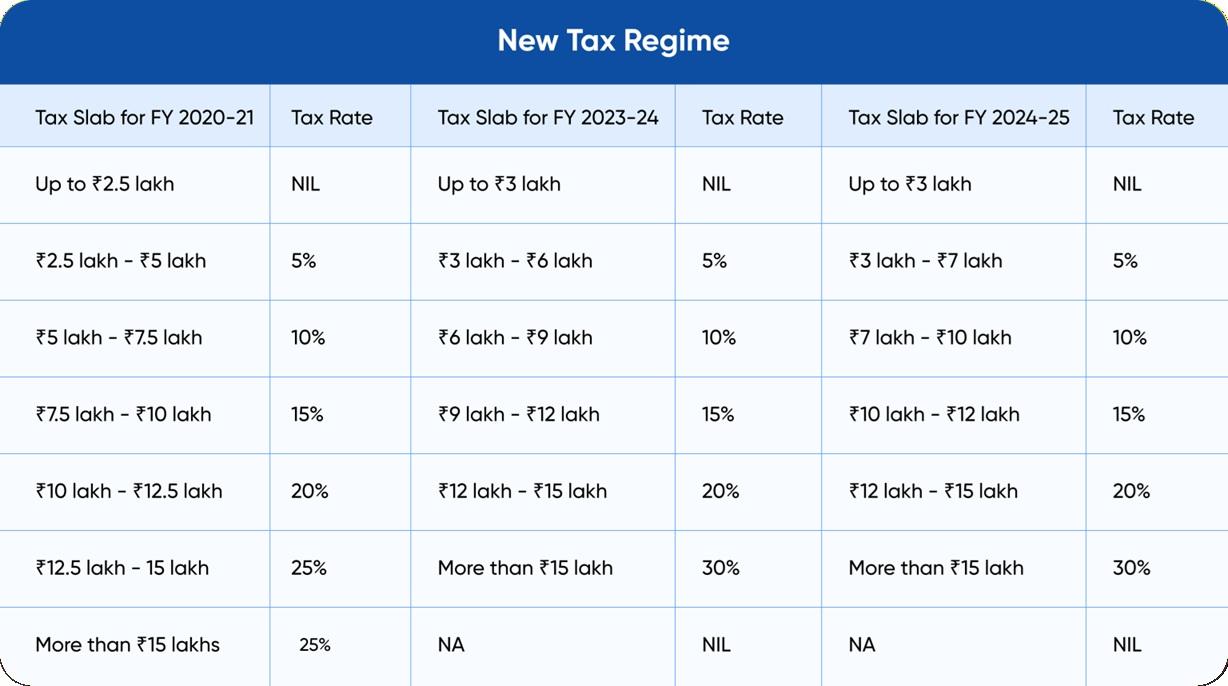
Old vs New Tax Regime 2026: Salary-Wise Calculator (₹5L to ₹50L)
Salary-wise calculator + decision rules for choosing between old and new tax regime in 2026 — what you actually save at ₹5L, ₹10L, ₹20L, and ₹50L income, with the 30-second decision shortcut.
HRA Exemption Calculator 2026: How Much Tax Can You Save?
How HRA exemption actually works in India — the three-rule formula, metro vs non-metro logic, the ₹1L landlord-PAN trap, and the ₹40,000 most salaried Indians lose every year.
PAN Card Apply Online 2026: Free vs Paid Methods Explained
Get an Indian PAN card in 10 minutes for free, or pay ₹107 for the physical card — full step-by-step for both, plus the ePAN trick most online services don't tell you about.